In an era defined by agentic commerce and digital money, corporate Asia faces a pivotal question: how do leaders reimagine work without fracturing the social contract with their workforce?
In the gleaming towers of Singapore's Marina Bay Financial Centre, Seetal Bhatti sits at one of the most consequential intersections in modern banking: where people meet technology.
As Global Head of HR for Technology & Operations at Standard Chartered (SC), appointed in January 2026, Bhatti is orchestrating a workforce transformation that could serve as a blueprint for corporate Asia.
SC's methodology — "zero-based design" — an approach that discards incremental thinking in favour of starting with a blank sheet of paper. "We are imagining what work will look like in the future and working back from there," Bhatti explains. "It requires us to think about the human and the digital interaction fundamentally and differently."
This is not merely an efficiency exercise. Bhatti is explicit: zero-based design is "about setting yourself up for the future, but really reimagining it, not iterating forward."
The questions she pose are deliberately disruptive: "What are our clients' expectations in the future? Which clients are we serving? Where are they? What do they need from us? How should work be designed to meet those expectations at the scale required?"
The approach resonates powerfully with broader trends sweeping across Southeast Asia. According to Deloitte's 2026 Global Human Capital Trends, 85% of leaders say adaptability is critical, yet only 7% believe they are truly ahead. The bank's zero-based design directly addresses this gap — it is not about adapting to change but architecting the future from first principles.
The skills-based organisation: Infrastructure for agility
At the heart of the zero-based design strategy lies a profound reframing: skills, not job titles, are the currency of work. SC has been on this journey for years, building what Bhatti describes as "the infrastructure that allows us to do that, the culture that allows us to do that, the leadership that allows us to do that."
The bank has built the infrastructure to enable this transition: an AI-enabled talent marketplace that maps skill supply against demand.
"Over 50% of our workforce have told us what their skills are, and they've been validated in the system. It matches the skill supply with the skill demand. And so far, we've seen 2,700 opportunities to match work projects to skills across the organisation," Bhatti reveals.
This capability is critical in a region where 63% of Southeast Asian companies report current skills gaps, according to AON's research consulting. Robert Walters' Salary Survey 2026 further highlights that 90% of employers in Asia plan salary increases in 2026, with 60% targeting increments of 3–6%, underscoring the premium placed on in-demand capabilities.
For operational leaders, the implication is clear: agility stems from visibility. By understanding the granular detail of skills—volume, location, and future demand—organisations can dynamically redeploy talent.
Bhatti cites a practical example: as operational requirements reduced in some areas, demand for relationship managers grew elsewhere. "Our ability to understand the skills that are relevant for relationship managers, find those in the operational teams, and then fly them… is what helps us balance those two things," she explains.
The multi-generational workforce: One size fits nobody
Bhatti is unequivocal about the diversity challenge: "We don't try to treat our colleagues as a one-size-fits-all. Not a homogeneous thing." This is particularly acute in Asia, where workplaces often span five generations — from Boomers to Generation Alpha.
Her solution is multifaceted. Leadership must role-model adaptability, demonstrating their own commitment to continuous learning.SC's "Global Learning Week" serves as a cultural anchor, with leaders publicly sharing their learning journeys.
But Bhatti goes further, insisting on "different learning interventions that different people, whether it is generational differences, or it might be other types of differences, learning styles, for example, can interact with."
Gartner's 2026 research reinforces this personalised approach, finding that organisations embedding adaptation into the flow of work — rather than through one-off change programmes — achieve dramatically better outcomes. The key is making change instinctive, not episodic.
Debunking the Ambition Gap Myth
Perhaps Bhatti's most passionate conviction concerns women in technology. "The ambition gap is a myth," she declares.
Seetal Bhatti
"Women tend to express it differently, their ambition. Often, they're not prepared to tolerate systems that are not designed to support them to reach their ambition." Seetal Bhatti
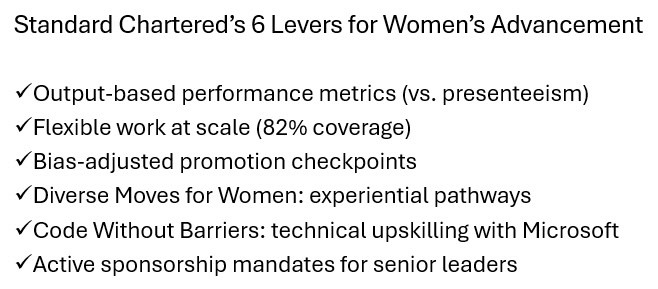
At SC, this translates into concrete structural interventions. The bank redefines high performance, moving away from "presenteeism" toward output-based evaluation. Flexibility is embedded at scale — 82% of the workforce have flexible working opportunities. Inclusion checkpoints are built into all people processes, with bias adjustments made during promotion and performance evaluations.
The numbers suggest progress: in 2025, 33% of senior leaders were female (up 8 percentage points since targeting began), 50% of the global management team were women, and 45.5% of the board were female. In technology specifically, Noelle Eder serves as global head — "still rare out there," Bhatti notes, "and we are very proud to have her as a role model."
This commitment to structural change rather than superficial fixes mirrors broader trends in Southeast Asia. Korn Ferry's 2026 Talent Acquisition Trendsreveal that 73% of leaders rank critical thinking as their top hiring priority — ahead of AI-related skills — recognising that human judgment remains the ultimate differentiator.
From vertical defenders to ecosystem orchestrators
As technology and operations blur into "TechOps," Bhatti is cultivating a new breed of leader. The era of "technologists that are sort of fixed in their domain and operational leaders that are fixed in their domain" is over, she asserts. The future belongs to "ecosystem orchestrators" who can straddle both worlds.
These leaders require three distinct capabilities: literacy in both operations and technology; the ability to take stakeholders on the transformation journey; and disciplined execution across both "run" and "change" agendas.
"They can equally sort of interrogate kind of architectural decisions, but they can talk about delivery models and impact on client outcomes," Bhatti explains.
"They can really build confidence in their teams, but also in their stakeholders that they can straddle both those things and understand and appreciate them and pay attention to the respective agendas." Seetal Bhatti
This convergence imperative is acute across Asia. Gartner predicts that 50% of current HR tasks will be automated or managed by AI agents by 2030, fundamentally transforming workflows. Yet only 6% of leaders globally say they are making progress in designing human-AI interactions, according to Deloitte. The orchestration challenge Bhatti describes is precisely where the competitive battle will be won.
The self-correcting architecture
Looking ahead 36 months, Bhatti acknowledges the impossibility of prediction. "None of us has a crystal ball to know what's going to happen in 12, let alone 36, at this point." Her response? Dynamic planning plus cultural resilience.
SC's presence across 54 markets provides natural shock absorption — "if you have a challenge in one market, you can divert to another market for their talent and skill base." But the deeper resilience comes from years of investment in skills-based infrastructure and adaptive culture.
This distributed resilience model is increasingly vital across Asia. Mercer's research finds that 72% of investors agree companies integrating human and AI capabilities will gain a competitive advantage, yet C-suite confidence in organisational readiness has declined — from 65% in 2024 to 51% in 2026. The gap between ambition and readiness makes Bhatti's long-term cultural investment particularly prescient.
Where Asia's HR revolution is heading
Bhatti's philosophy ultimately centres on what Deloitte terms the "Human Advantage" — the multiplier effect when human creativity, judgment, and adaptability are intentionally combined with AI's speed and scale.
She identifies five "skills to win": leadership, global business perspective, problem-solving, resilience and adaptability, and human-AI collaboration.
This human-centric emphasis is where 2026's most sophisticated HR strategies converge. Korn Ferry finds that while 84% of talent leaders plan to use AI in 2026, 73% rank critical thinking as their most needed skill, with AI expertise placing only fifth. The message is clear: technology is the enabler, but human judgment is the differentiator.
For HR professionals navigating this complexity, Bhatti offers straightforward counsel: "See them as opportunities, not problems. Have a growth mindset. Stay optimistic, be a problem solver, and network with other HR and business professionals to understand what's going on out there in other organisations so you can bring the best of it back to your organisation."
In an era where Gartner warns that the employment deal is shifting toward "give more, expect less," Bhatti's optimism is deliberately grounded.
She understands that the future belongs not to organisations that merely adopt AI, but to those that redesign work around human potential. The blank sheet of paper, it turns out, is not empty — it is filled with possibility.
Action checklist
Audit your skills inventory: Map current capabilities against 36-month strategic priorities.
Embed inclusion by design: Build bias checks into promotion workflows—not as an add-on, but as infrastructure.
Pilot an internal talent marketplace: Start with one business unit; measure redeployment velocity before scaling.
Allan is Group Editor-in-Chief for CXOCIETY writing for FutureIoT, FutureCIO and FutureCFO. He supports content marketing engagements for CXOCIETY clients, as well as moderates senior-level discussions and speaks at events.
Previous Roles
He served as Group Editor-in-Chief for Questex Asia concurrent to the Regional Content and Strategy Director role.
He was the Director of Technology Practice at Hill+Knowlton in Hong Kong and Director of Client Services at EBA Communications.
He also served as Marketing Director for Asia at Hitachi Data Systems and served as Country Sales Manager for HDS’ Philippine. Other sales roles include Encore Computer and First International Computer.
He was a Senior Industry Analyst at Dataquest (Gartner Group) covering IT Professional Services for Asia-Pacific.
He moved to Hong Kong as a Network Specialist and later MIS Manager at Imagineering/Tech Pacific.
He holds a Bachelor of Science in Electronics and Communications Engineering degree and is a certified PICK programmer.