
Gartner has warned that enterprises risk a growing talent exodus if they fail to match AI adoption with a people-centric strategy, as organisations accelerate their shift towards AI-enabled operating models.
According to the firm, by 2027, 50% of enterprises without a comprehensive approach to workforce enablement will lose their top AI talent to competitors that prioritise human-centric transformation over basic technology deployment.
Among participants to Gartner’s Global Labor Market Survey only 27% of CxOs report having a comprehensive AI strategy in place, while just one in five believe their workforce is genuinely AI-ready.
This disconnect, Gartner argues, is fuelling what it describes as an “enablement illusion” — where leaders equate access to AI tools with meaningful transformation.
“The survey revealed that in the shift to an AI-powered workforce, most leaders are mistaking basic access or adoption metrics for transformation,” said Swagatam Basu, senior director analyst at Gartner. “This ‘enablement illusion’ is hiding risks and draining ROI.”
At the centre of the challenge are four workforce dynamics that organisations must address to unlock value from AI investments.
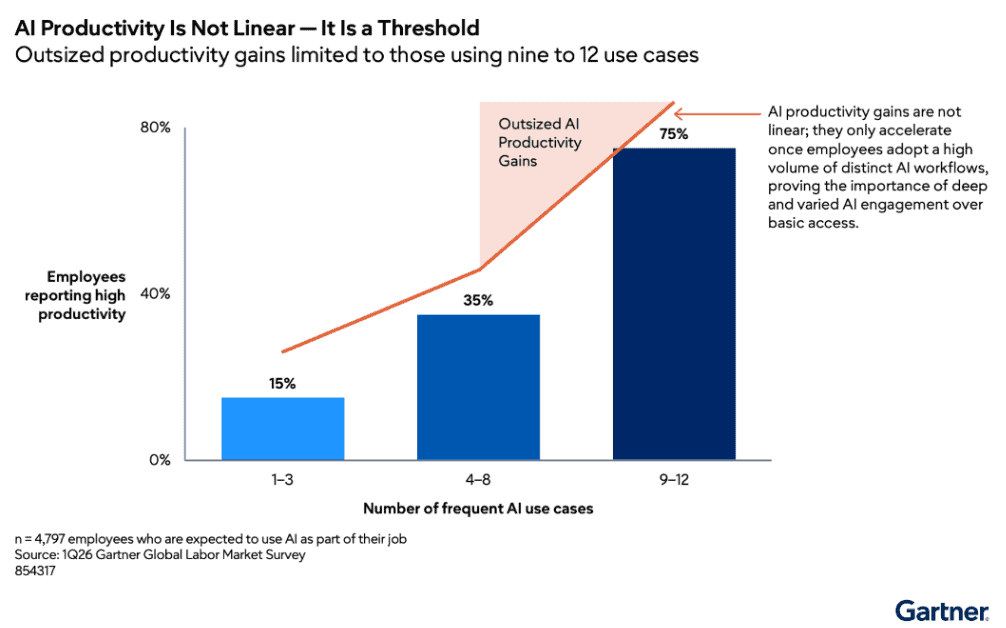
First, measuring success purely by time saved is proving insufficient. Nearly one in five employees report no time savings from AI, underscoring the limitations of simplistic productivity metrics. Gartner instead points to depth and diversity of AI usage as a more accurate indicator of value creation, with proficient users significantly more likely to deliver higher-quality work and process improvements.
Second, the rise of “shadow AI” is complicating enterprise control. While 88% of employees with access to corporate AI tools also use personal AI solutions for work, this hybrid usage increases both data risk and attrition. Employees often turn to external tools for better user experience, signalling gaps in enterprise platforms that CIOs and CHROs must urgently address.
Third, AI benefits remain unevenly distributed across organisations. While access to tools is widespread, highly productive users are disproportionately concentrated among managers and executives. Individual contributors — who perform much of the work most amenable to automation — are frequently underserved in terms of training and support, limiting enterprise-wide impact.
Finally, workforce sentiment is emerging as a critical barrier. Anxiety around job displacement continues to dampen adoption, with Gartner emphasising that AI transformation is as much a cultural shift as a technological one. Employees who feel confident about their future roles are significantly more likely to embrace AI and perform at higher levels.
“The most effective drivers of positive AI adoption are employee confidence in their current and future roles, and transparent, ongoing communication about how AI will be used,” Basu added.
For COOs and HR leaders, the message is clear: competitive advantage in the AI era will hinge less on tool deployment and more on how effectively organisations enable, engage and retain their people. Without that shift, even the most advanced AI investments may struggle to deliver sustained value.