
Enterprise AI is boosting task speed but eroding productivity across ASEAN as employees lose more than a full work day each week switching between disconnected tools and systems, according to new research from Workday.
The report, “The Copy/Paste Economy: Why Task-Oriented AI Is Failing the Enterprise”, finds that around one in five ASEAN employees lose over seven hours a week moving information and reconciling data, offsetting the time saved by AI on individual tasks.cpl.thalesgroup
Engagement high, but manual integration burdens staff
Despite the friction, the ASEAN workforce remains highly engaged. Nearly nine in 10 employees report a strong sense of progress, ownership and connection to organisational goals, even as they are buried in manual integration work.
Some 86% say AI has improved their day-to-day work experience, yet 66% spend at least half their time translating and coordinating between systems and teams, and only 30% of organisations have embedded AI into the core of their business.
“The real friction is structural – unclear guidance, inconsistent outputs, and tools that don’t integrate where work actually happens,” said Jess O’Reilly, general manager, ASEAN, Workday.

“Organisations need to move beyond task-based AI use cases to an operating model where AI is integrated within the flow of work for greatest effectiveness.” Jess O'Reilly
Administrative friction stalls decisions and drains time
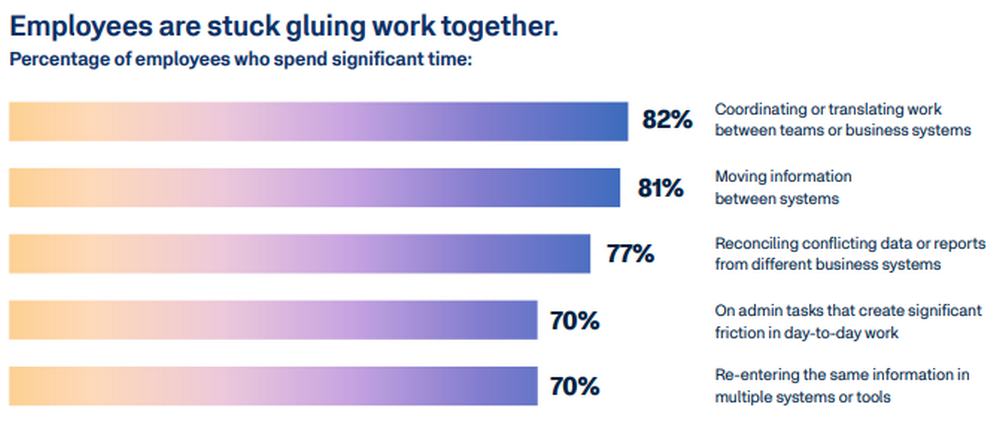
The research highlights persistent administrative barriers that limit AI’s payoff. More than eight in 10 employees spend significant time moving information between systems, while 84% devote substantial effort to coordinating work across teams or business systems.
Inconsistent data compounds the problem: 82% regularly spend significant time reconciling conflicting information across multiple systems, and 76% say administrative or bureaucratic tasks create significant day-to-day friction.
Decision-making is also affected. Three-quarters of ASEAN employees say decisions are delayed when information is missing or unclear, and 72% report that teams often disagree over whose numbers are right.
Even as workers remain optimistic about AI and believe it helps them complete individual tasks more quickly, four in five say navigating processes and systems is a source of stress.
Moving beyond the copy/paste economy
Workday argues that ASEAN organisations can unlock greater value from AI by prioritising integration over standalone applications. When AI is embedded directly into core business platforms rather than layered onto fragmented technology stacks, employees spend less time manually moving information and more time on work that drives business impact.
The implication for COOs is clear: the next productivity gains will come less from adding more task-oriented AI tools and more from redesigning operating models so that AI lives inside the systems where finance, HR and IT work actually happens.