
Asia Pacific is outpacing other regions in adopting artificial intelligence across core commercial real estate (CRE) functions, yet the region also confronts the world’s most severe AI talent shortfall, according to JLL’s 2026 Future of Work Survey.
The study, which canvassed more than 2,200 C‑suite and CRE leaders across 21 countries, highlights a paradox: high adoption ambition alongside limited readiness to capitalise on it.
Adoption outstrips capability
JLL’s data shows APAC leading globally in AI use for technology management (52%), portfolio optimisation (51%) and CRE strategy development (47%).
Despite this, only 15% of organisations report they are in an optimisation phase of AI adoption — having moved beyond pilots to scale — while 46% remain in monitoring mode and 40% are still analysing potential impacts. Just 31% are actively redesigning workplaces for human‑AI collaboration.
“The companies pulling ahead aren’t necessarily the ones with the biggest budgets; they are the ones building adaptive capability and treating AI as a growth enabler, not just a cost lever,” said Susheel Koul, CEO Real Estate Management Services, APAC at JLL. “Left unaddressed, that gap has the potential to compound quickly, which is why closing the skills and capability gap now matters more than ever.”
Skills gap emerges as primary barrier
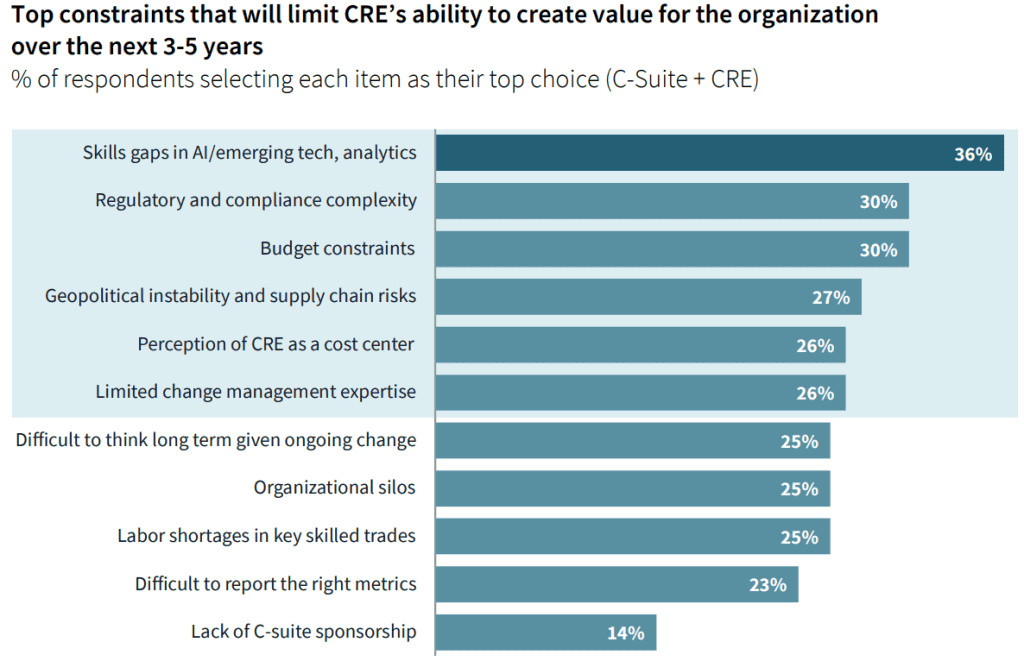
For the first time in 15 years of this research, skills shortages — specifically in AI, analytics and emerging technologies — have overtaken budget constraints as the top obstacle to CRE value creation.
Globally, 36% of respondents cited skills gaps as the principal barrier; in APAC the figure rises to 42%. Nearly half of APAC organisations (49%) expect talent scarcity driven by AI reskilling demands to shape their workforce over the next three to five years.
Risk and governance concerns
The survey also surfaces an evolving risk profile. Technology‑related issues dominate portfolio risk assessments, including cybersecurity and data privacy (47%), technology or AI disruption (41%) and uncertainty about AI’s impact on space (40%).
APAC respondents express even greater anxiety about AI disruption (44%), reflecting both the region’s heavy reliance on technology and tighter regulatory and data‑sovereignty pressures.
Workplaces will not disappear
Contrary to fears of wholesale desk cuts, JLL finds that most leaders expect workforces to expand (61%).
“The organisations furthest along in their AI journey are doubling down on their physical environments because the higher‑value, more cognitively demanding work that AI enables requires spaces that help people think, focus and connect,” said Kamya Miglani, head of research, REMS, APAC.
She contends that the research disproves the widespread assumption that AI will reduce the need for physical workplaces.She adds that "technology and workspace experience should not be competing priorities; together, they form the foundation for sustained cognitive performance."
Practical responses
JLL recommends three strategic responses: operational optimisation in constrained markets, strategic outsourcing to bridge capability gaps without surrendering control, and capability building for organisations prepared to invest in upskilling, change management and measurement tools.
Bridging the talent divide will be central to turning APAC’s AI ambition into measurable CRE performance gains.