
• About
  • Subscribe
  • Contact
Monday, October 12, 2026
    Login
FutureIOT
  • Technology
    • Sensors and Instrumentation
    • Devices
    • Cloud and Platforms
    • Research and Development
    • Governance, Standards and Regulations
    • Application and Middleware
    • Security
    • Big Data and Analytics
    • AI and Machine Learning
  • Industry
    • Manufacturing
    • Transportation and Logistics
    • Retail and E-commerce
    • Banking and Financial Services
    • Government, Healthcare and Education
    • Industrial
  • Application
    • Smart Cities
    • Future Workplace
    • Commercial
    • Smart Home
    • Customer Engagement
  • Resources
  • Podchats
  • Videos
  • Events
No Result
View All Result
  • Technology
    • Sensors and Instrumentation
    • Devices
    • Cloud and Platforms
    • Research and Development
    • Governance, Standards and Regulations
    • Application and Middleware
    • Security
    • Big Data and Analytics
    • AI and Machine Learning
  • Industry
    • Manufacturing
    • Transportation and Logistics
    • Retail and E-commerce
    • Banking and Financial Services
    • Government, Healthcare and Education
    • Industrial
  • Application
    • Smart Cities
    • Future Workplace
    • Commercial
    • Smart Home
    • Customer Engagement
  • Resources
  • Podchats
  • Videos
  • Events
No Result
View All Result
FutureIOT
No Result
View All Result
Home Industry Construction

Singapore bets big on low-carbon construction

by Allan Tan
October 12, 2026
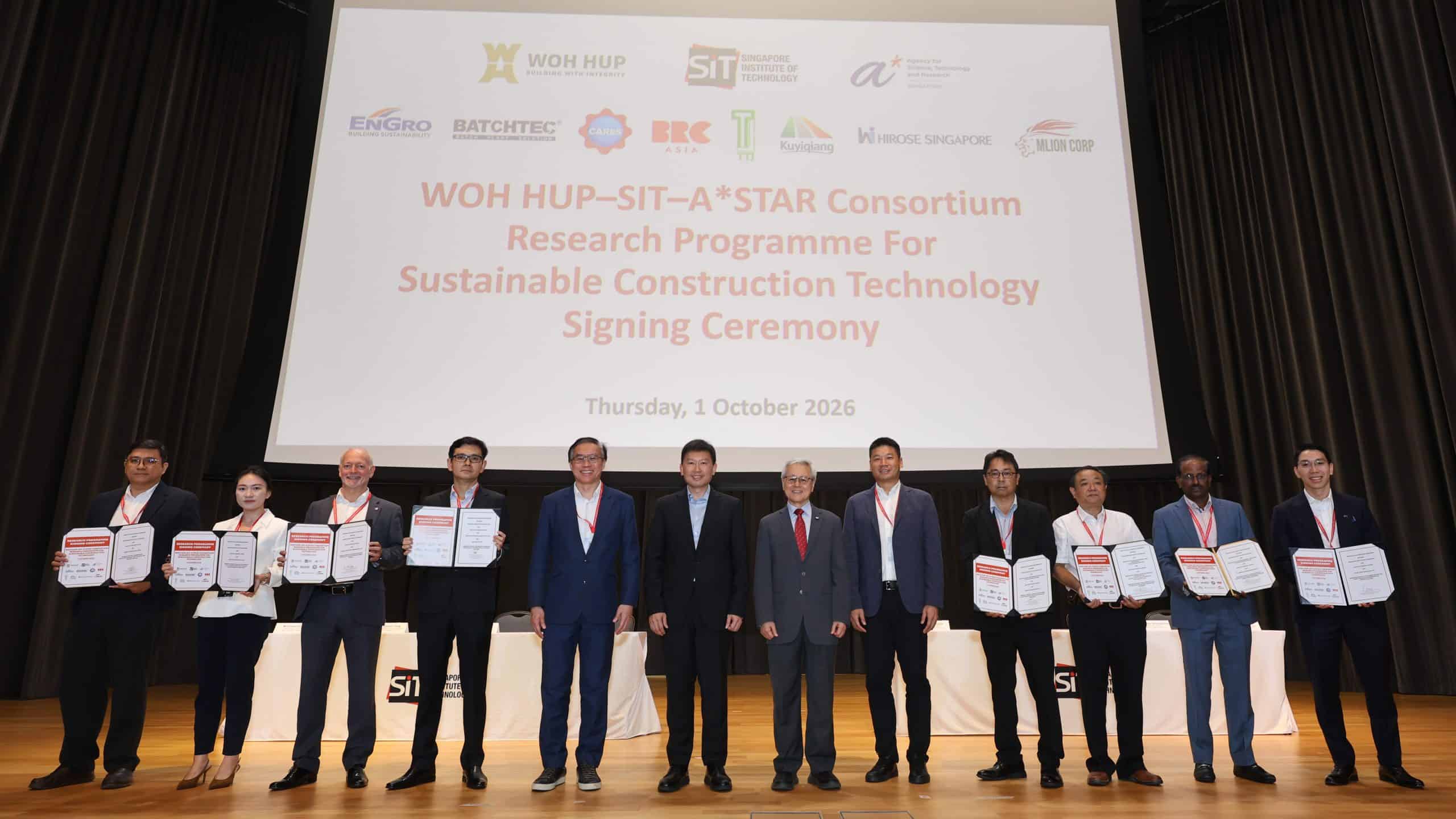
Official Signing Ceremony for Woh Hup–SIT–A_STAR Consortium for Sustainable Construction Technology

Official Signing Ceremony for Woh Hup–SIT–A_STAR Consortium for Sustainable Construction Technology

Singapore's construction sector is being squeezed from every direction. Developers face tightening carbon regulations, rising material costs and volatile supply chains. Financiers increasingly tie capital to ESG performance. Clients demand greener buildings without paying premium prices. And the workforce must deliver more with fewer hands.

The pressure is not theoretical. Embodied carbon — the emissions locked into materials like concrete and steel — is now a board-level concern across real estate, infrastructure and manufacturing.

Yet the industry has historically moved slowly, hamstrung by thin margins, fragmented supply chains and a reluctance to adopt unproven technologies. The graveyard of sustainable construction is filled with promising prototypes that never survived contact with a live project site.

The mandate is clear: innovate, but at scale. Reduce carbon but protect productivity. Adopt new technologies but manage risk. Meeting these competing imperatives requires something the sector has rarely achieved — sustained, pre-competitive collaboration between researchers, contractors and industry partners.

The challenge: Adoption, not invention
Chiew Sing Ping

Professor Chiew Sing Ping, head of the Construction Technology Innovation Laboratory (CTIL) and Cluster Director for Engineering at SIT, frames the predicament with precision: "The built environment sector is facing increasing pressure to reduce embodied carbon while improving productivity and resource efficiency. The challenge is not simply to develop new technologies, but to ensure they can be adopted at scale and create meaningful impact for industry."

That distinction — between invention and adoption — is the intellectual foundation of the S$30.4 million Woh Hup–SIT–A*STAR Consortium for Sustainable Construction Technology. Singapore does not lack for promising research. It lacks a reliable pathway from laboratory validation to live project sites. The consortium is designed to be that pathway.

Minister for National Development Chee Hong Tat, who witnessed the consortium's signing, made the same point bluntly: "What really matters is not just to do the research, but whether good ideas and research can ultimately be translated into practical solutions." Speaking at the CTIL Annual Technical Seminar, he positioned the new programme as "one of the largest private-sector R&D investments in the Built Environment sector to date."

From lab to live sites

The three-year programme brings together SIT, A*STAR, Woh Hup (Private) Limited and seven other industry partners around a deliberately practical structure. Industry partners contribute project sites, operational expertise and validation environments, allowing technologies to be tested under actual construction conditions rather than controlled settings.

As Professor Chiew puts it: "By working closely with industry partners throughout the research process, we can accelerate the translation of these innovations into practice while developing the talent needed to support the sector's transformation."

Chee Hong Tat

Minister Chee praised this co-investment model, noting that at CTIL "companies bring forward their challenges, researchers contribute expertise, partners co-invest, and real-world construction projects provide opportunities to test the new solutions."

The scale of industry investment is notable — a meaningful share of roughly 10% of the built environment sector's annual business expenditure on R&D. This is not grant-dependent research. It is industry capital deployed with commercial intent.

Seven projects, one 40% target

The programme's seven research projects address the sector's most pressing challenges. Among them: scaling up ultra-low embodied carbon concrete production, developing AI-powered design tools that optimise structural designs for lower embodied carbon, cost and material use, exploring greener construction materials from demolition waste, and advancing structural-steel reuse.

SIT's award-winning ultra-low carbon concrete — already demonstrated to cut embodied carbon by up to 65% — will be scaled up under the programme. By 2029, the consortium targets up to 40% reduction in embodied carbon in urban development applications compared with conventional approaches, alongside new business opportunities and operational cost savings for industry partners.

Talent as strategic infrastructure

Professor Chiew is explicit that technology alone is insufficient. The programme embeds undergraduate and postgraduate students, research staff and industry professionals within industry-led projects, creating a pipeline of engineers fluent in AI-enabled design, sustainable materials and data analytics — "a form of strategic infrastructure as important as any physical asset."

Minister Chee reinforced the point that innovation is not only technological. He announced new BCA–LTA guidelines to improve diaphragm wall construction quality, expected to cut reinforcement usage by about 10% and generate potential savings of up to S$3 million per kilometre of D-wall.

"Sometimes, it means taking a fresh look at the way we do things today," he said. "It is both regulatory and policy innovation, which must go hand in hand if we want to achieve the benefits of technology and research innovation at scale."

Five years of proof

The consortium builds on CTIL's track record since 2021, when it began as an SIT–Woh Hup partnership with close to $6 million in R&D investment. It now spans 13 applied research projects with 26 industry partners, five technologies deployed on actual projects, and recognition at the Institution of Engineers Singapore's Prestigious Engineering Achievement Award in 2024.

Government support is scaling in parallel. Minister Chee announced $112 million over five years under the RIE2030 Cities of Tomorrow R&D Programme, alongside the Urban Solutions and Sustainability Translation Fund launched earlier this year to help companies bridge the "valley of death" between prototype and market.

The win-win-win imperative

For business leaders, the message is unambiguous. Minister Chee framed the payoff as a "win-win-win": companies save money, time and manpower; workers gain safer, higher-value jobs; and the sector becomes more competitive and productive. Early adopters gain a competitive edge in tendering for green-financed projects and meeting ESG mandates.

But the Minister also issued a challenge: "What we cannot achieve is to push for transformation alone." He urged more companies across the value chain to come forward with pain points, participate in pilot projects and invest in promising solutions.

The consortium offers a rare combination — shared risk, real-world validation and a clear carbon-reduction target. In a sector known for incrementalism, this is a step change worth watching.

Related:  AI-powered surveillance to boosts business efficiency
Tags: A-Starlow-carbon constructionSingapore Institute of Technology (SIT)Woh Hup

Allan Tan

Allan is Group Editor-in-Chief for CXOCIETY writing for FutureIoT, FutureCIO and FutureCFO. He supports content marketing engagements for CXOCIETY clients, as well as moderates senior-level discussions and speaks at events. Previous Roles He served as Group Editor-in-Chief for Questex Asia concurrent to the Regional Content and Strategy Director role. He was the Director of Technology Practice at Hill+Knowlton in Hong Kong and Director of Client Services at EBA Communications. He also served as Marketing Director for Asia at Hitachi Data Systems and served as Country Sales Manager for HDS’ Philippine. Other sales roles include Encore Computer and First International Computer. He was a Senior Industry Analyst at Dataquest (Gartner Group) covering IT Professional Services for Asia-Pacific. He moved to Hong Kong as a Network Specialist and later MIS Manager at Imagineering/Tech Pacific. He holds a Bachelor of Science in Electronics and Communications Engineering degree and is a certified PICK programmer.

No Result
View All Result

Recent Posts

  • Singapore bets big on low-carbon construction
  • AI rewrites the design, delivery and resilience of Asia’s infrastructure
  • Trust and privacy concerns temper AI adoption in business travel
  • OUP study finds Hong Kong educators embracing AI amid well-being concerns
  • Singapore employees feel ‘always-on’ pressure despite greater flexibility

Categories

  • Agriculture
  • AI and Machine Learning
  • Application
  • Application and Middleware
  • Artificial Intelligence
  • Automotive
  • Banking and Financial Services
  • Big Data and Analytics
  • Blockchain
  • Case Studies
  • Change Healthcare
  • CHRO
  • CISO
  • CISO strategies
  • Cloud and Platforms
  • Cloud, Platforms and Ecosystems
  • Cloud, Virtualization, Operating Environments and Middleware
  • Commercial
  • Compliance and Governance
  • Compliance and Governance|Technology
  • Computer, Storage, Networks, Connectivity
  • Construction
  • Consumer
  • Culture and Behaviour|People
  • Customer Engagement
  • Cybersecurity careers
  • Cybersecurity operations
  • Data Protection
  • Data Protection
  • Devices
  • Digital Transformation
  • Endpoint Security
  • ESG
  • ESG and sustainability
  • Future Workplace
  • FutureCISO
  • FutureCOO
  • Governance, Risk and Compliance
  • Governance, Standards and Regulations
  • Government, Healthcare and Education
  • Hospitality and Tourism
  • HR, education and Training
  • Industrial
  • Industry
  • IT-OT integration
  • Manufacturing
  • Networking
  • Operations
  • People
  • Process
  • Remote work
  • Research and Development
  • Retail and E-commerce
  • Risk Management
  • Security
  • Sensors and Instrumentation
  • Smart Cities
  • smart contracts
  • Smart Home
  • Start-ups
  • Supply chain
  • Tactics and Strategies
  • Technology
  • Telecommunications
  • TIBCO
  • Training and awarenes
  • Transportation and Logistics
  • Videos
  • Vulnerabilities and threats
  • Whitepapers

About FutureIoT

Asia’s ONLY dedicated IoT publication

The race to harness the power of Internet of Things (IoT) is here. FutureIoT is dedicated to individuals, as well as public and private organizations looking to tap the potential of IoT to transform the way we live, work and do business. FutureIoT is the dedicated media that provides the single source of truth about IoT, the technology, its application and regulation, originating from Asia. << Read more >>

Quick Links

  • Subscribe
  • Contact
  • Privacy Policy
  • Cookie Policy
  • Terms of Use

Categories

Recent News

Official Signing Ceremony for Woh Hup–SIT–A_STAR Consortium for Sustainable Construction Technology

Singapore bets big on low-carbon construction

October 12, 2026
Bentley Systems announced the winners of the 2026 Year in Infrastructure Awards on October 7, 2026 (Photo courtesy of Bentley Systems)

AI rewrites the design, delivery and resilience of Asia’s infrastructure

October 9, 2026
  • Privacy Policy
  • Terms of Use
  • Cookie Policy

Copyright © 2022 Cxociety Pte Ltd | Designed by Pixl

Login to your account below

or

[wpli_login_link]

Not a member yet? Register here

Forgotten Password?

Fill the forms bellow to register

All fields are required. Log In

Retrieve your password

Please enter your username or email address to reset your password.

Log In

Add New Playlist

No Result
View All Result
  • Technology
    • Sensors and Instrumentation
    • Devices
    • Cloud and Platforms
    • Research and Development
    • Governance, Standards and Regulations
    • Application and Middleware
    • Security
    • Big Data and Analytics
    • AI and Machine Learning
  • Industry
    • Manufacturing
    • Transportation and Logistics
    • Retail and E-commerce
    • Banking and Financial Services
    • Government, Healthcare and Education
    • Industrial
  • Application
    • Smart Cities
    • Future Workplace
    • Commercial
    • Smart Home
    • Customer Engagement
  • Resources
  • Podchats
  • Videos
  • Events
Login

Copyright © 2022 Cxociety Pte Ltd | Designed by Pixl

Subscribe