In 2026, infrastructure conversations fundamentally shifted, with sustainability no longer primarily an environmental agenda. It now encompasses economic competitiveness, supply security, and climate resilience as integrated priorities. Asia Infrastructure Forum 2026
Asia’s infrastructure sector stands at a decisive inflexion point. Economic pressures, regulatory mandates, technological disruption, and the limits of traditional business processes are reshaping how projects are conceived, financed, built, and operated.
The challenge is immense. Low- and middle-income economies across the region will require roughly US$2.6 trillion a year in transport infrastructure investment between 2025 and 2035, according to the Asian Transport Observatory (ATO).
The ATO estimates that roads alone account for around US$1.14 trillion of that annual need. At the same time, the Asian Development Bank has committed to mobilising US$70 billion by 2035 for cross-border power grids and digital networks, reflecting the dual imperatives of energy security and AI-driven growth.
Economic realities are unforgiving. Data-centre capacity in Asia-Pacific is projected to rise from about 32 gigawatts in 2025 to 57 gigawatts by 2030, driven largely by AI workloads. This creates unprecedented demand for reliable, low-carbon electricity and transmission infrastructure that can move renewable power across borders.
Financing gaps remain wide; public-private partnerships are still relatively rare outside Australia, and many projects struggle with unclear returns or limited long-term funding. Regulatory frameworks are tightening around climate resilience, emissions reduction and water security.
China’s dual-carbon goals, national adaptation plans across Southeast Asia, and increasingly stringent requirements for non-revenue water reduction all force owners and contractors to embed sustainability and risk mitigation from the earliest design stages.
Technology is the most visible agent of change. Artificial intelligence, digital twins, geospatial intelligence and reality modelling are moving from pilot projects into mainstream practice. Business processes, however, have lagged.
Data remains fragmented across design, construction and operations. Institutional knowledge is often locked inside specialised software or the heads of senior engineers. Industry leaders already cite talent shortages in AI and cybersecurity as a material barrier.
The result is a sector that must deliver more complex, more resilient assets faster and with tighter margins while simultaneously building the digital foundations required for the next generation of projects.
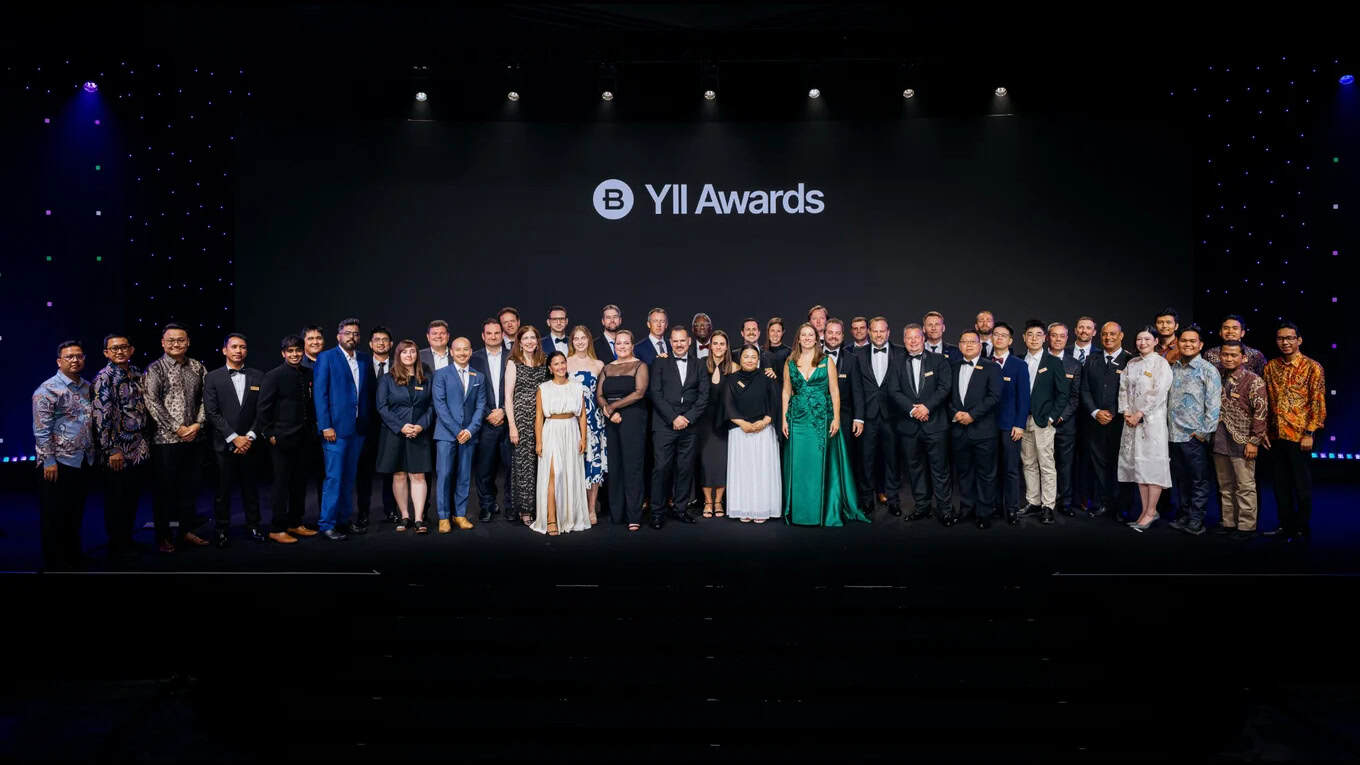
These pressures formed the backdrop to the Bentley Systems Year in Infrastructure. The associated awards programme provided a concentrated view of how practitioners across the region and beyond are responding.
In his keynote address, Bentley CEO Nicholas Cumins used the submissions to map the emerging contours of infrastructure AI and to set out the conditions under which it can create lasting value.
AI as the new computational paradigm
Cumins began by recalling the 2004 BE Awards, when computational design and GenerativeComponents first allowed teams to explore complex options algorithmically. Of Foster + Partners’ work on 30 St Mary Axe, he observed: “Models that took days to draft manually could be programmatically generated within minutes.”
Keynote address by Nicholas Cumins, CEO, Bentley
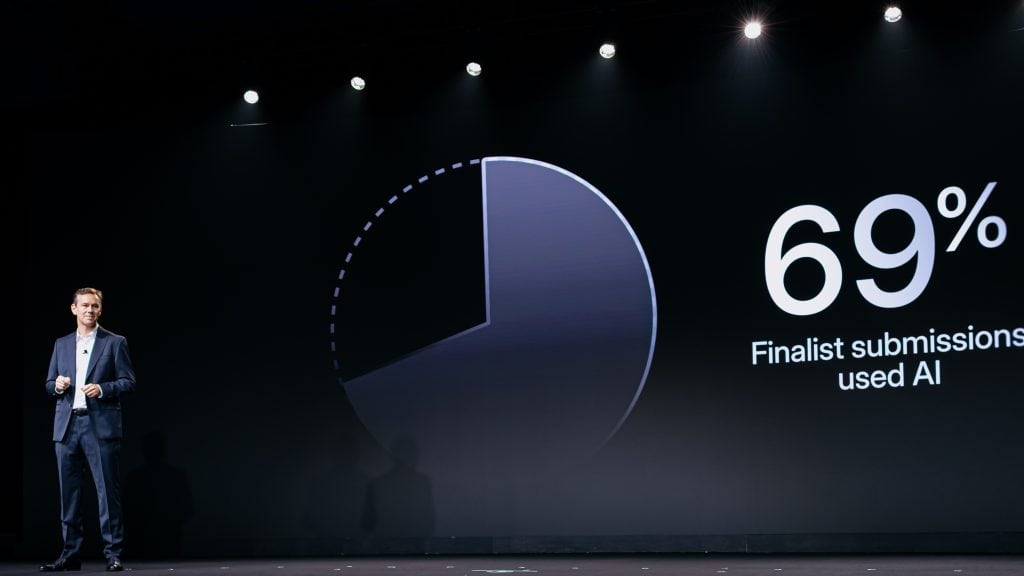
Twenty-two years later, AI represents the next paradigm shift. “In this year’s submissions, close to 70% of our finalists—and more than 25% of all submissions—used AI in their project,” he reported.
AI is already appearing across planning, design, construction, and operations, and solutions originally developed for asset monitoring are moving up into the construction phase.
He focused particular attention on design, where decisions exert an outsized influence on both capital cost and long-term performance. Across the submissions, a clear pattern emerged: organisations are using AI first to expand engineering capacity amid surging demand, then directing that additional capacity toward deeper optimisation.
Two examples illustrated the point.
On a complex metro tunnel project beneath a historic city, one team deployed AI agents to evaluate more than one hundred geotechnical simulations against strict design criteria. The immediate efficiency gains included a 30% reduction in design cost; the expanded exploration also produced a materially better solution that saved 4,500 cubic metres of concrete.
On a large offshore wind development requiring multiple jacket foundations capable of withstanding extreme waves and typhoon conditions, another organisation built an automated optimisation platform around an established structural solver. Optimisation cycles ran ten times faster, and steel material costs fell by 3 to 5%, equating to significant tonnage savings across the foundation set.
Both teams wrote custom code—an obstacle Cumins acknowledged remains out of reach for most firms.
The progressive roll-out of Model Context Protocol servers across Bentley’s applications is intended to lower that barrier, enabling engineers to interact with software in natural language and allowing AI to translate intent into instructions on the fly.
Capacity, optimisation and the adoption reality
The same dual logic—capacity expansion followed by deeper optimisation—is visible across Asia’s infrastructure markets. Digital twins of campuses and urban districts unify previously disconnected operational data, improve predictive maintenance, and reduce both cost and resource intensity.
Conversational interfaces layered onto federated digital twins let non-specialists extract cost, carbon, and compliance information in seconds rather than days. In the energy domain, full-lifecycle modelling and AI-assisted simulation are being applied to complex underground and offshore schemes to compress schedules, manage geotechnical risk and meet stringent environmental constraints.
Geospatial intelligence fused with AI is improving predictions of landslides, flood risk, and other natural hazards that threaten linear assets and power infrastructure.
Yet the ICE roundtable underscores why progress remains uneven. Participants noted that only around one-third of white-collar staff at large contractors have tried AI at work. Contractors operating on thin margins are naturally cautious: “Who in this industry will risk profit on IT?” asked one engineering and digital director.
Digital maturity is markedly higher among large consultancies than among contractors and subcontractors; digitalisation is simply “not percolating down.” Project teams under intense pressure to demonstrate best value often default to traditional delivery methods because clients remain difficult to persuade.
Anxiety about job security further dampens enthusiasm. As one director observed, adopting technology solutions needs to address job security explicitly if the workforce is to engage rather than resist.
These cultural and commercial barriers don't negate the technical potential; they explain why AI and digital twins are diffusing more slowly and unevenly than the most optimistic technology roadmaps suggest.
Guardrails: Human judgement and deep context
Cumins tempered optimism with responsibility. Natural-language AI's accessibility removes the steep learning curve that once confined advanced computational methods to a handful of marquee projects.
That democratisation, however, introduces a new risk he termed “AI sloppiness.” In infrastructure engineering, “precision is a non-negotiable, and the margin for error is zero.”
He identified two essential guardrails. First, human judgement must govern AI use. “Optimisation belongs to the machine. But navigating the trade-offs belongs to the engineer.”
Project specifications are filled with competing priorities—constructability versus long-term resilience, speed versus environmental risk—that calculation alone cannot resolve.
Nicholas Cumins
“An algorithm should not decide what is best for a community, or what is an acceptable risk for the environment. And above all… an algorithm does not sign and stamp the drawings.” Nicholas Cumins
That professional stamp continues to represent accountability for public safety. Organisations must therefore hire, promote and empower engineers who combine intellectual curiosity with rigorous critical thinking.
Second, AI must be grounded in deep context. Clear intent is the necessary starting point: if requirements, boundary conditions and performance criteria are ambiguous, AI will generate hundreds of optimised answers to the wrong problem.
Context must then extend to site realities, engineering standards and institutional experience. Without that grounding, even the most capable models produce options you can't trust.
Building a durable corpus
Cumins argued that the practical embodiment of deep context is creating what he called a “Durable Corpus.” Drawing on an advanced platform developed by one international firm, he described three digital threads that organisations must systematically capture:
The Design Journey (the decisions, rationale and alternatives explored, not merely the final deliverables),
The As-Built Reality (changes during construction that keep the digital twin accurate and feed constructability insight back into future design), and
The Operational Truth (long-term performance data that reveals how designs behave over decades).
When these threads are unified inside a federated digital twin underpinned by a robust semantic schema, generic AI becomes an organisation-specific competitive advantage.
“AI is only as powerful as the corpus of truth behind it,” Cumins says. The ability to query not only a model's current state but also its full design history further multiplies the value of that corpus.
This concept aligns closely with emerging practice across Asia. Reality-capture programmes at city scale, continuous monitoring on major construction sites, and the progressive integration of operational sensor data into network models all point toward the same destination: data that is connected, contextual and available across the entire asset lifecycle.
The future is now
Five interlocking trends emerge from the current landscape.
First, AI and digital twins are being adopted faster to expand capacity and enable deeper optimisation across the infrastructure lifecycle.
Second, the rapid expansion of renewable generation, storage and intelligent grids required both to meet decarbonisation targets and to power the AI economy itself.
Third, the mainstreaming of climate and disaster resilience as a core performance requirement rather than a compliance overlay.
Fourth, the continued need for large volumes of transport and urban infrastructure to accommodate urbanisation and improve connectivity. Fifth, the growing use of geospatial intelligence and reality modelling to support risk-informed decisions from planning through operations.
These trends are mutually reinforcing and inherently multi-year. Major tunnels, pumped-storage schemes, high-speed rail corridors, city-scale digital foundations and cross-border transmission systems do not appear overnight. The capabilities and institutional practices taking shape in 2026 will continue to mature through 2027 and well into the following decade.
Cumins closed by placing Bentley firmly in the optimist camp. “We believe AI is ushering in a new golden age for infrastructure engineering—one where the value created across the entire lifecycle will be so significant that all boats will rise.”
The evidence from Asia’s infrastructure markets suggests that optimism is justified—provided the industry maintains professional judgement, invests in durable data foundations, and treats AI as an amplifier of engineering excellence rather than a substitute for it.
The organisations that succeed will treat every project as an opportunity to enrich their corpus of truth, turning today’s AI experiments into tomorrow’s institutional advantage.
Allan is Group Editor-in-Chief for CXOCIETY writing for FutureIoT, FutureCIO and FutureCFO. He supports content marketing engagements for CXOCIETY clients, as well as moderates senior-level discussions and speaks at events.
Previous Roles
He served as Group Editor-in-Chief for Questex Asia concurrent to the Regional Content and Strategy Director role.
He was the Director of Technology Practice at Hill+Knowlton in Hong Kong and Director of Client Services at EBA Communications.
He also served as Marketing Director for Asia at Hitachi Data Systems and served as Country Sales Manager for HDS’ Philippine. Other sales roles include Encore Computer and First International Computer.
He was a Senior Industry Analyst at Dataquest (Gartner Group) covering IT Professional Services for Asia-Pacific.
He moved to Hong Kong as a Network Specialist and later MIS Manager at Imagineering/Tech Pacific.
He holds a Bachelor of Science in Electronics and Communications Engineering degree and is a certified PICK programmer.