*Editor's note: "As an employee tasked with understanding as much about technology, innovation, the drive to growth and stay resilient, and the importance of recognising that our workforce are not on equal footing when it comes to tech awareness, training and adoption, dabbling in iterations of generative AI (GenAI) is a continuing exercise in learning how to ask question(s), scrutinising the responses for correctness (AI lies), and building a trust (while always being on guard against hallucinations. My limited advantage is applying logic programming methods to thought and question development.
Forrester’s latest research on workplace AI adoption delivers a sobering message for COOs: employee readiness is not keeping pace with AI‑tool deployment, and the gap is now a visible drag on productivity and return on investment.
In his blog “Your Employees Aren’t Ready For AI — And It’s A Problem”, Forrester analyst J.P. Gownder argues that organisations are investing heavily in AI suites while failing to equip staff with the understanding, skills and ethical guardrails they need to use them effectively.
J.P. Gownder
"Employers aren’t successfully equipping their employees with the understanding, skills, and ethics to succeed in a world of AI. And it’s becoming a bottleneck that inhibits productivity and return on investment." J.P. Gownder
AIQ reveals a persistent readiness gap
At the heart of the argument is Forrester’s AIQ (Artificial Intelligence Quotient), a framework that measures employee readiness across four dimensions: understanding of AI, hard skills and training, confidence and motivation, and ethics, risk and privacy awareness.
The latest data show that AIQ has barely budged year‑on‑year, despite widespread rollout of tools such as Microsoft 365 Copilot, Google Workspace with Gemini and enterprise‑grade ChatGPT.
In a March 2026 post, Gownder writes that employers “aren’t successfully equipping their employees with the understanding, skills, and ethics to succeed in a world of AI,” and that this deficit is turning into a bottleneck that inhibits productivity and return on investment.
"But adaptation isn’t coming quickly or easily. Many employers remain mired in an environment of low skills and employee fears that isn’t conducive to successfully adopting workforce AI or driving productivity from its use." Forrester
That view is echoed in secondary coverage, which notes that AI‑decision‑makers say AI tools are in use, yet only about half of organisations report offering AI‑related training to non‑technical staff.
This narrow gain underscores how marginal the progress has been, despite the hype around AI‑enabled productivity suites. In a separate interview, Gownder describes the prevailing assumption that AI tools are simple enough to be self‑teaching as a “lie” that underestimates the learning curve and over‑estimates instant payoff.
Behavioural and ethical hurdles
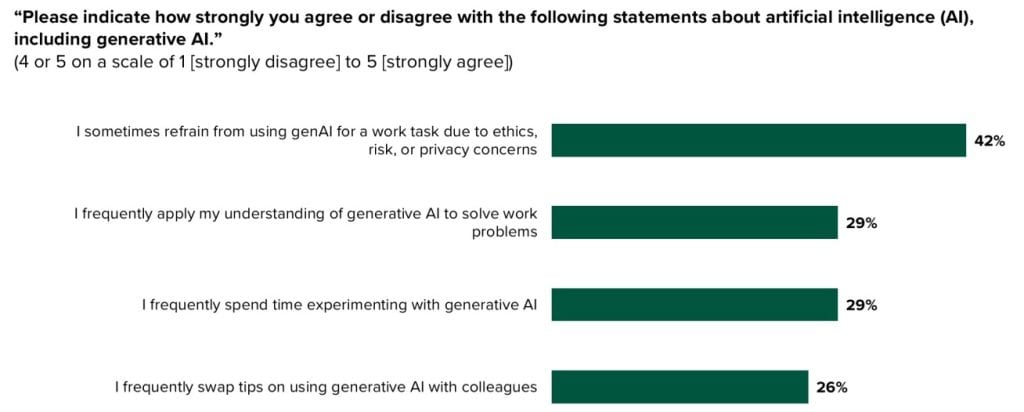
Beyond technical skills, the research highlights behavioural and psychological barriers. Forrester’s 2026 AIQ 2.0 work shows that fewer than 40% of employees feel confident adapting to AI‑driven work, less than half are motivated to build AI skills, and only 44% say they feel confident using AI responsibly and ethically.
Source: Forrester's Future of Work Survey, 2025
Without deliberate intervention, low‑AIQ workers are more likely to adopt tools slowly, misuse or over‑rely on them, or fall back onto legacy workflows, effectively neutralising the efficiency gains companies expect.
For COOs and operations leaders, this means that AI‑driven process change is not just about licenses and integration; it is about trust, perceived risk, and individual comfort with new ways of working. Forrester’s earlier piece on AI‑workforce readiness already warned that low AI literacy leads to poor adoption and eroded trust in AI, a trend the 2026 data reinforce and 2026 predictions on AI‑driven training mandates.
A strategic playbook for operations leaders
The narrative that Forrester and Gownder are building is that AI‑workforce readiness cannot be an afterthought. In the 2026 blog, the implication is clear: AIQ is a leading indicator of whether AI‑driven workflows will actually improve performance or merely mask underlying inefficiency.
Forrester’s 2026 predictions underline this by forecasting that 30% of large enterprises will begin to mandate AI training, explicitly to lift adoption and reduce risk.
For operations leaders, that translates into a need for structured AIQ‑building: prompt‑engineering workshops, AI‑fluency curricula, and leadership‑driven use‑case curation aligned to business outcomes, rather than a one‑off briefing or “self‑service” assumption.
For COOs, the takeaway is simple: AI‑driven productivity will remain a theory until AI‑readiness becomes a formal, measured, and managed capability across the organisation.
Allan is Group Editor-in-Chief for CXOCIETY writing for FutureIoT, FutureCIO and FutureCFO. He supports content marketing engagements for CXOCIETY clients, as well as moderates senior-level discussions and speaks at events.
Previous Roles
He served as Group Editor-in-Chief for Questex Asia concurrent to the Regional Content and Strategy Director role.
He was the Director of Technology Practice at Hill+Knowlton in Hong Kong and Director of Client Services at EBA Communications.
He also served as Marketing Director for Asia at Hitachi Data Systems and served as Country Sales Manager for HDS’ Philippine. Other sales roles include Encore Computer and First International Computer.
He was a Senior Industry Analyst at Dataquest (Gartner Group) covering IT Professional Services for Asia-Pacific.
He moved to Hong Kong as a Network Specialist and later MIS Manager at Imagineering/Tech Pacific.
He holds a Bachelor of Science in Electronics and Communications Engineering degree and is a certified PICK programmer.