DHL Supply Chain announced a significant expansion of its data centre logistics capabilities across Asia Pacific, aimed at keeping pace with accelerating AI-driven demand and the execution realities facing hyperscalers and data centre operators.
The programme adds more than 160,000 square metres of dedicated warehousing capacity across the region. DHL already operates over 30,000 sqm in-service, while a further 130,000 sqm of committed expansion and built-to-suit developments in Malaysia and Thailand are scheduled to come online over the next two years.
The company said the move is directly aligned with the forecast that Asia Pacific will overtake the United States as the largest global data centre market by 2030.
DHL also linked the capacity build-out to a broader industry backdrop: the sector is expected to grow from US$23 billion in 2025 to roughly US$35 billion by 2030, with mounting pressure on operators to hit tighter timelines, manage increasingly complex cross-border supply chains and move high-value equipment into live construction environments.
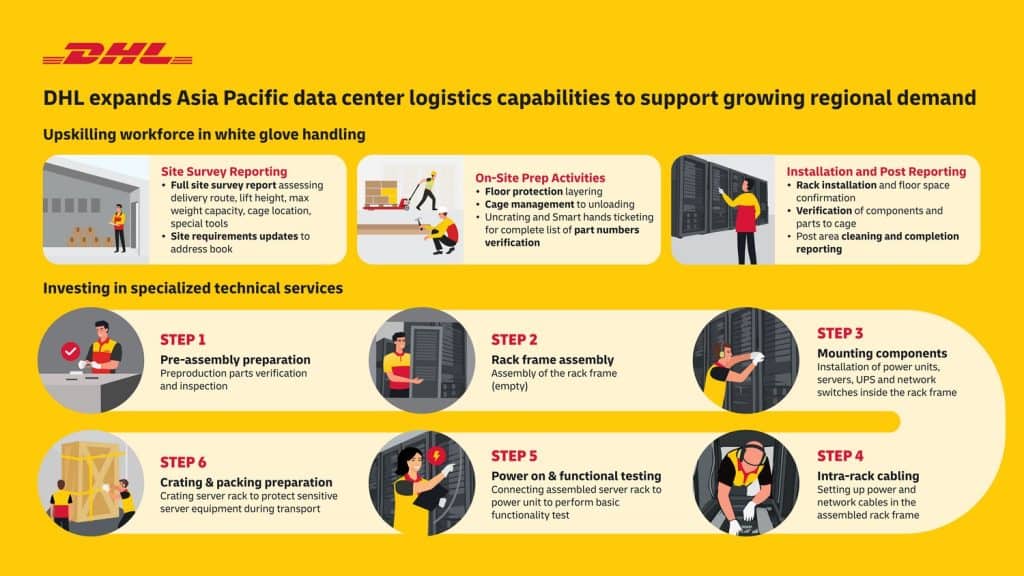
DHL’s approach goes beyond additional storage. A key element is the upskilling of its workforce, including advanced “white glove” handling and investment in specialised technical services, designed to move critical preparation and integration work away from crowded construction zones and into controlled logistics environments.
In a move intended to reduce deployment risk, “white glove handling” supports servers and critical systems through a managed chain of custody, including site survey reporting and route assessments, plus on-site preparation steps such as floor protection, cage management and part-number verification. DHL also highlighted downstream support including rack installation, component verification, area cleaning and completion reporting.
To address installation complexity, DHL is building technical capability into dedicated teams operating from purpose-built logistics hubs. Services listed include server rack frame assembly, intra-rack cabling, functional testing, and secure packaging to protect sensitive equipment in transit—aiming to reduce on-site congestion and support schedule continuity even as infrastructure density rises.

DHL’s investment is supported by executive commentary from the expansion’s regional leadership: “Market projections show Asia Pacific as the world’s next data center hub, with approximately USD$800 billion (~€730 billion) in data center investment expected across the region by 2030,” said Javier Bilbao, CEO, Asia Pacific, DHL Supply Chain.
“As the region enters this sustained phase of large-scale data center execution, customers need more than capacity; they need execution certainty.” Javier Bilbao
At group level, DHL reinforced the strategic importance of the segment, citing ongoing global momentum and end-to-end execution. The company noted it has recently expanded data centre logistics infrastructure in North America and is now scaling further in Asia Pacific to deliver integrated lifecycle support across regions.