Enterprise AI spending across Asia Pacific (APAC) is accelerating at pace, but a new survey suggests many organisations are moving with urgency driven more by fear of being left behind than by demonstrable business returns.
According to the latest IDC InfoBrief (commissioned by Expereo), around 70% of organisations are investing in AI, motivated either by its potential or competitive pressure. Yet boards are struggling to translate ambition into measurable outcomes: 20% say they are investing aggressively in AI with little evaluation, explicitly linked to fear of falling behind.
Source: IDC 2026
The APAC pressure point
The Fear Of Missing Out or FOMO dynamic appears sharper in APAC. Thirty-seven per cent of organisations say they are investing aggressively with little evaluation—nearly double the global average. The survey highlights the pressure is most acute in Australia (45%) and Vietnam (44%), while Singapore also shows a notably high level of uncertainty, with more than one in three organisations reporting the same approach.
Eric Wong, president, APAC, Expereo, says: “Asia Pacific is moving aggressively on AI adoption, but many organisations are discovering that scaling AI successfully requires more than just investment in applications and models. The underlying network, cloud connectivity, and operational readiness matter just as much.
Eric Wong
"Across the region, we are seeing enterprises reassess whether their infrastructure is truly ready to support AI at scale, particularly around performance, resilience, governance, and visibility. Organisations that address those foundations early are generally seeing stronger outcomes and faster operational impact from their AI initiatives.” Eric Wong
Outcomes lag behind hype
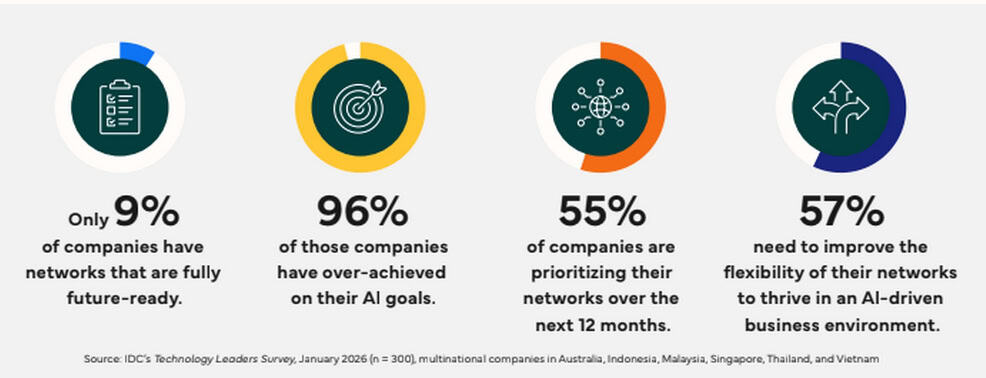
While AI is widely prioritised, results are mixed. The InfoBrief reports that 51% of organisations globally plan to prioritise AI or machine learning over the next 12 months—rising to 61% across APAC.
But performance is not matching expectations: globally, only 19% of organisations say their AI implementations have exceeded expectations, and just 5% report they have significantly exceeded them.
In APAC, 40% report AI has exceeded or significantly exceeded expectations—an improvement versus global figures, but still leaving most organisations unconvinced.
The leading causes of underperformance are stark: poor-quality or inadequate training data (51%), cost overruns or ROI not achieved (47%), and AI not performing as expected (46%).
The network problem
Where AI initiatives stall, the survey points beyond models and data—towards connectivity and infrastructure readiness. Globally, 26% of organisations whose AI failed to meet expectations cite inadequate networks as a contributing factor, while 54% say they need more flexible and scalable networks and 51% want greater resilience and reliability to maximise uptime.
Ben Elms
“Every enterprise we speak to is investing in AI, yet the data shows a clear gap opening up between AI ambition and AI outcomes. More often than not, that gap comes down to the network underneath," says Ben Elms, CEO, Expereo.
"Getting the network right is no longer an IT decision; it is one of the most important conversations happening in the boardroom today.” Ben Elms
Boardroom risk: security, cost visibility and governance
The survey also flags growing anxiety about AI-related risk and cost control. Fifty-four per cent of global tech leaders cite the creation of new security risks as a significant future threat, while 39% worry they may lose track of AI-related costs and ROI once AI is embedded across the business.
Meanwhile, digital sovereignty is rising as a strategic priority across APAC, with 38% rating it high or top priority.