
Singaporean businesses are moving faster and with greater ambition on AI than most of their global peers, according to PwC’s Global AI performance study, but gaps in governance and workflow integration mean local firms are not yet at the level of the world’s top “AI leaders”.
The study, which surveyed over 1,200 senior executives worldwide, shows that 67% of Singapore businesses report a higher risk appetite for AI investment than the global average of 41%, and 63% align people and budgets around AI opportunities, compared with 51% globally.
Singapore’s AI trajectory
PwC says local firms are also more aggressive in how they compete: 43% use AI to compete beyond their sector, versus 20% globally, and 30% report having eliminated outdated IT infrastructure, ahead of the 18% global figure.
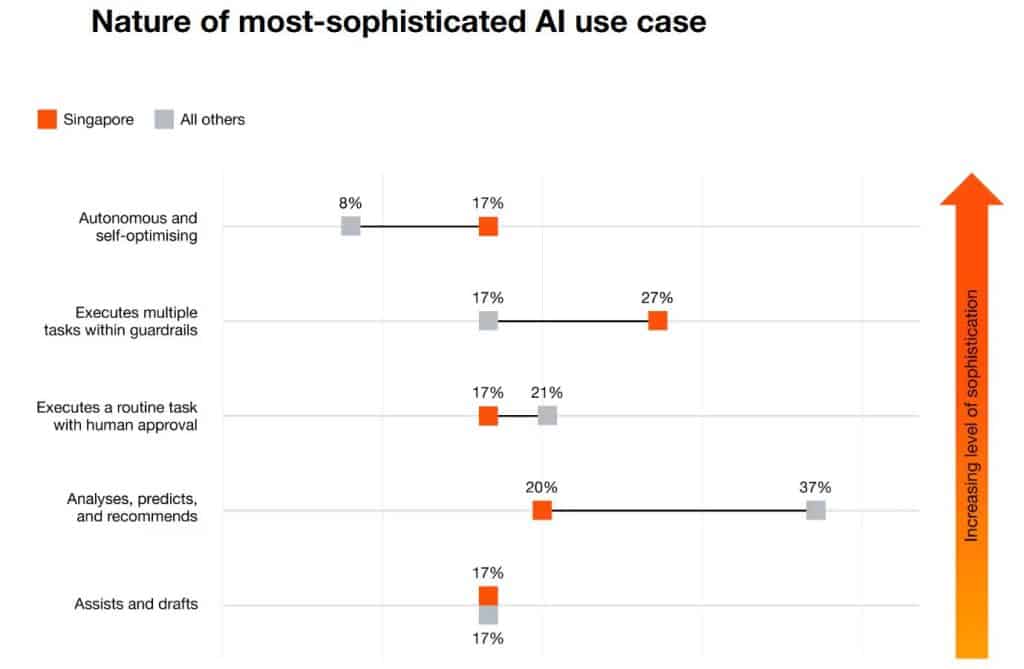
Singapore businesses are less likely than peers worldwide to deploy AI only for basic analytics, prediction and recommendations and more likely to use it in autonomous or self‑optimising modes, which PwC sees as a sign of higher‑order maturity.
However, when benchmarked against the top 20% of AI‑driven performers—the “AI leaders”—Singapore still lags in several key areas. Only 53% of Singapore respondents have robust, up‑to‑date security for AI and data, versus 69% of AI leaders, and 47% have a documented responsible‑AI framework and 43% a cross‑functional AI governance board, compared with 63% and 64% among leaders, respectively.
Data governance and workflow redesign are also weaker: 37% of local firms have a single trusted record of critical data and 37% have redesigned workflows to embed AI, versus 59–60% and 56% among AI leaders.
What top performers do differently
Globally, AI leaders generate 7.2× more AI‑driven revenue and efficiency gains than their peers and invest 2.5× more, while also being 2.4× more likely to maintain reusable AI components and 1.7× more likely to ensure high‑quality data is available for priority use cases.

“The companies achieving the highest AI‑driven returns globally are distinguished not by how much they spend, but by how deliberately they operate,” said Anthony Dias, AI hub leader, PwC Singapore.
“They make targeted choices about where AI creates value, embed it into core workflows, and scale what works consistently across the enterprise. Trust is a critical enabler in this equation, and organisations that establish strong governance, transparency and accountability frameworks are better positioned to deploy AI with confidence and at scale.” Anthony Dias
Singapore’s national AI agenda—backed by the IMDA‑led AI Verify Foundation, the Global AI Assurance Pilot, and the 2026 National AI Missions across manufacturing, connectivity, finance and healthcare—creates a supportive environment, but the report underscores that local firms still need to tighten governance, data, and workflow design if they are to match global AI leaders