Automating frontline care and construction roles would be markedly more expensive than retaining human staff, according to a June 2026 analysis from scheduling platform Planera.
The study compared government wage data with real-world prices from automation vendors to estimate the annual cost of replacing one worker with machines, factoring purchase, installation, maintenance and the human supervision still required.
High-cost roles at the top
Source: Planera 2026
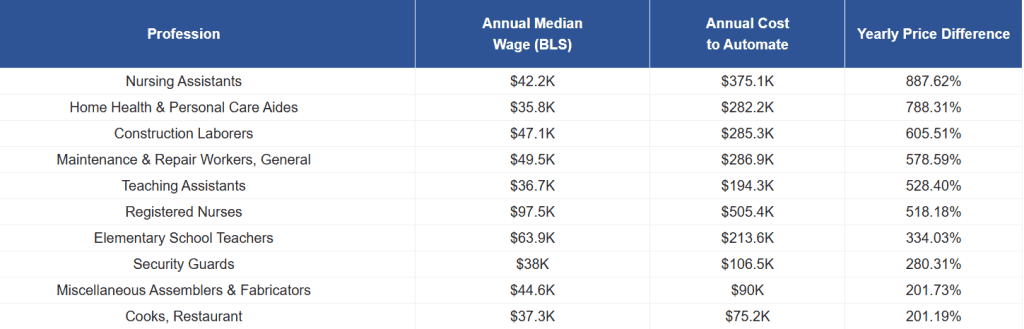
Planera’s ranking of 30 common US occupations places nursing assistants as the most expensive to automate. With a median wage of US$42,200, the platform estimates the annual cost to replace one nursing assistant at around US$375,100 — nearly nine times the worker’s salary.
Home health and personal care aides follow closely: automation would cost an estimated US$282,000 a year against a median wage of US$35,800, an eightfold multiple.
Construction labourers are also expensive to displace. The report estimates automation would cost roughly US$285,000 per worker annually, about six times the median pay of US$47,000. Planera highlights that no commercial robot yet handles the full physical and variable demands of a building site, making full replacement uneconomical for now.
Maintenance, repair and teaching assistants
Maintenance and repair workers rank fourth, with an annual automation price near US$287,000 versus a US$49,500 median wage. The study assigns a high “difficulty index” to these roles because they require diagnostic judgement across diverse equipment types — another area where general-purpose robots are not yet viable.
Teaching assistants are the fifth-most costly role to automate. Replacing one would cost about US$194,000 per year, more than five times the US$36,800 salary. Planera argues that supervision, classroom safety and the social aspects of supporting pupils remain firmly human responsibilities.
Cheaper automation exists, but not always preferable
Not all occupations are expensive to automate. Planera identifies cashiering as the least costly conversion, with self‑checkout systems estimated at roughly US$24,000 per year — cheaper than employing a cashier. That disparity reflects the maturity of certain automation technologies and the relative simplicity of the tasks involved.
A broader labour-market implication
Planera’s spokesperson framed the findings as a rebuttal to the idea that low-paid, low-skill roles are automatically most vulnerable to automation. “For years, the assumption was that low-paid, low-skill jobs would be the first to go. But the data shows the opposite,” they said.
“The workers earning the least tend to be doing the most physically demanding, human-facing work — and that turns out to be exactly what machines struggle with most. It is white-collar roles that are now more exposed.” Planera
The report underlines a nuanced picture for developers and employers weighing automation: upfront technology costs, ongoing operation and residual supervisory labour can make displacement financially impractical for many frontline occupations, even where social and regulatory pressures push towards automation.