
Gartner has identified three technology trends expected to shape government investment, operating models and public service delivery as agencies respond to the growing impact of artificial intelligence, evolving cyber threats and rising citizen expectations.
Gartner said public sector leaders are under pressure to modernise operations, strengthen cyber resilience and govern AI at scale while managing economic and geopolitical uncertainty.
“Government CIOs are operating in one of the most disruptive periods in recent memory,” said Dean Lacheca, vice-president analyst at Gartner. “AI is reshaping how governments deliver services; cyber threats are evolving faster than traditional defences can respond to; and agencies are under increasing pressure to achieve more with finite resources.”
The first trend, managing the ripple effect of agentic AI, reflects the shift from isolated experimentation towards enterprise-wide deployment. Gartner said AI agents will increasingly support government operations, citizen services, software development and routine decision-making.
Lacheca said the discussion around AI must move beyond technology implementation towards organisational transformation. Government agencies will need updated governance frameworks, digitally capable workforces, redesigned processes and outcome-based roadmaps, supported by clear measures of value.
The second trend is the need for an “always evolving” cybersecurity culture. Gartner said advances in AI, geopolitical tensions and quantum computing are changing the threat landscape and making periodic reviews and compliance-led approaches insufficient.
“Cybersecurity can no longer be treated as a static function,” said Lacheca. He said resilience, automation and crypto-agility should become core elements of government cybersecurity strategies, alongside stronger visibility of digital supply chains and third-party risk.
The third trend involves rethinking how government technology services are delivered. Gartner said future-ready agencies will require digital- and AI-literate workforces, adaptive operating models and governance structures that encourage innovation while preserving accountability.
“Technology will only ever be a tool or a trigger; transformation is ultimately about people,” said Lacheca.
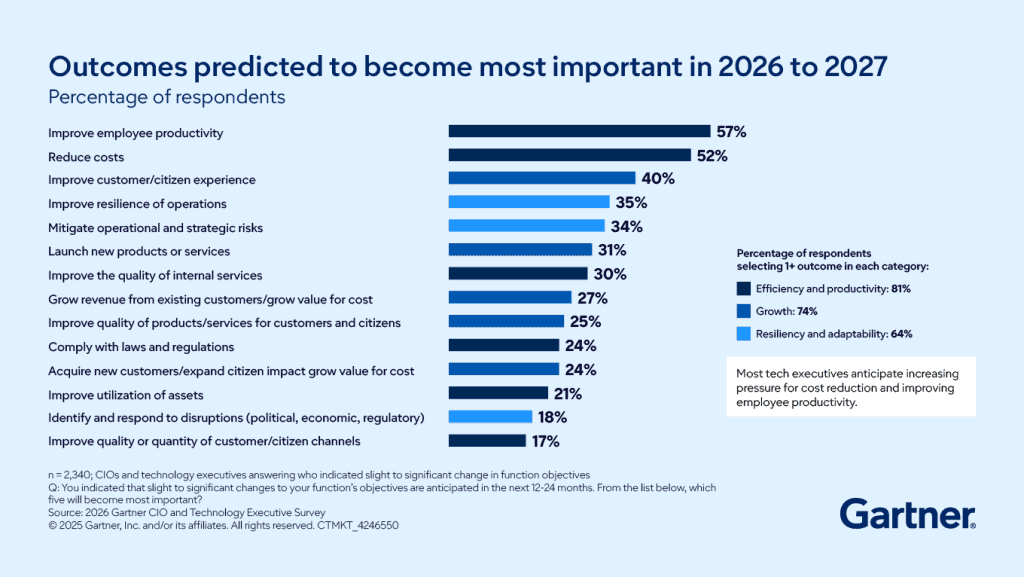
According to a Gartner survey of 1,219 CIOs and IT leaders conducted in January 2026, 78% of government respondents expected to invest in their people to advance key technology initiatives. Gartner recommends that agencies prioritise AI literacy, workforce modernisation and organisational flexibility as they seek to improve efficiency and meet rising service demands.