Since the 1970s, companies like Toyota and Hyundai have deployed robots in production to create faster and safer working environments for humans. Humanoid robots represent the next evolution. The core logic remains unchanged: machines handle dangerous, physically demanding, and repetitive tasks, freeing humans for higher-value activities.
As Asia’s manufacturing sector confronts acute labour shortages and rising wages, AI-powered robots—spanning collaborative robots (cobots), autonomous mobile robots (AMRs), swarm intelligence platforms, and emerging humanoids—are accelerating the shift toward Industry 5.0, where human-machine collaboration drives productivity.
Deloitte’s February 2026 report highlights the momentum: 84% of Singapore businesses expect to implement physical AI within the next two years, up from 53% today.
Globally, the humanoid robot market is projected to reach US$6.24 billion in 2026, with Asia-Pacific accounting for 42.6% of that, driven by China, Japan, and South Korea. Yet adoption is pragmatic.
As Andy Zheng, general manager of Lenovo Manufacturing Solutions, notes in a March 2026 interview, “If wheels can do the job, we do not need legs on the shop floor. And if three fingers can grasp an item, we do not need dexterous human-like hands.”
Swarm Intelligence and Physical AI deliver the biggest wins
Swarm intelligence and physical AI deliver the strongest near-term gains. Zheng distinguishes two high-impact AI types: “swarm intelligence” orchestrates fleets of robots from multiple brands into a unified system, turning an entire warehouse into “a united giant single robot.”
Physical AI, by contrast, equips robots to perceive and manipulate real-world objects by modelling properties like weight, friction, and texture.
In warehouses and logistics—key pain points across Singapore, Malaysia, China, and Hong Kong—swarm intelligence already drives ROI. Lenovo’s deployment for ST Logistics in Singapore automated 90% of pallet-to-loose-item handling by late 2024 using robots from three manufacturers on a shared digital map.
Similar projects are scaling regionally and into Saudi Arabia and Australia. Physical AI shines in final-mile taskssuch as picking varied SKUs, though Zheng cautions it currently handles only 50–60% of items in easier environments and 20–30% in complex retail settings.
Opportunities are largest where labour shortages bite hardest. Repetitive lifting, inspection, and light assembly in China’s auto and electronics lines, Japan’s precision small-batch work, and Singapore’s logistics hubs show the fastest payback.
Zheng explains: “Young people are less inclined to perform laborious, physical work… Repetitive, tedious tasks are often not attractive even if the wages are high.”
Physical AI transforms real-time decisions and factory efficiency
Physical AI moves beyond pre-programmed scripts by creating virtual twins of the physical world for rapid training—sometimes 10–1,000 times faster than real-world testing—then deploying learned behaviours on robots.
Zheng defines it as “translating physical objects and environments into a virtual model… to include physical properties such as weight, friction, texture, and other real-world dynamics.” This enables adaptive manipulation: an AMR arm picking irregular shapes or planning motions around inertia.
Efficiency gains are already measurable. In Lenovo’s own operations, unified AI platforms optimise robot fleets, energy use, and workflows.
Zheng predicts physical AI will soon surpass human-designed processes.
Andy Zheng
“Today, many assembly… steps are still designed based on human experience… Physical AI begins by learning from that, but in the future, it should be able to identify more efficient ways.” Andy Zheng
NVIDIA CEO Jensen Huang declared that “the ChatGPT moment for robotics is here,” forecasting a surge in industrial automation.
Preparing workers for human-robot collaboration
Human-robot collaboration is inevitable and transformative. Zheng compares it to the office shift from PowerPoint experts to Agentic AI users: “A new type of engineer or worker will be needed. They will need to understand the basic principles of human-robot collaboration… and also know how to train AI.”
Senior technicians who once excelled at machine operation will be valued for robot collaboration and AI training skills.
Manufacturers must invest now in upskilling. Technical institutions should develop courses on intuitive interaction, AI training, and hybrid oversight. In ageing societies like Japan, Korea, and China, or labour-tight Singapore, this reframes displacement fears into empowerment—freeing workers for creative, judgment-based roles while robots handle tedium.
Building oversight as robot autonomy grows
Safety remains paramount as autonomy grows. Zheng cites a cautionary February 2026 incident where Meta’s AI alignment director, Summer Yue, lost control of an agentic AI tool (OpenClaw) that began deleting her emails due to context compression overriding safety rules.
His solution: “Use AI to monitor AI… only with the equivalent computing and the reasoning capability, we can have the possibility to identify all the potential risks.”
Current deployments balance 70% programming and 30% physical AI to manage risk. Lessons from cobots and AMRs—layered human-in-the-loop oversight and pre-programmed guardrails—will scale to humanoids. Regulatory lags across Asia underscore the need for proactive, AI-augmented safety frameworks.
Practical priorities for lasting ROI in Industry 5.0
Practicality trumps hype. Zheng advises: “Use simple fit-for-purpose robots for specific tasks instead of overengineering human-like features… focus on the ROI and start POC from a very small scale.”
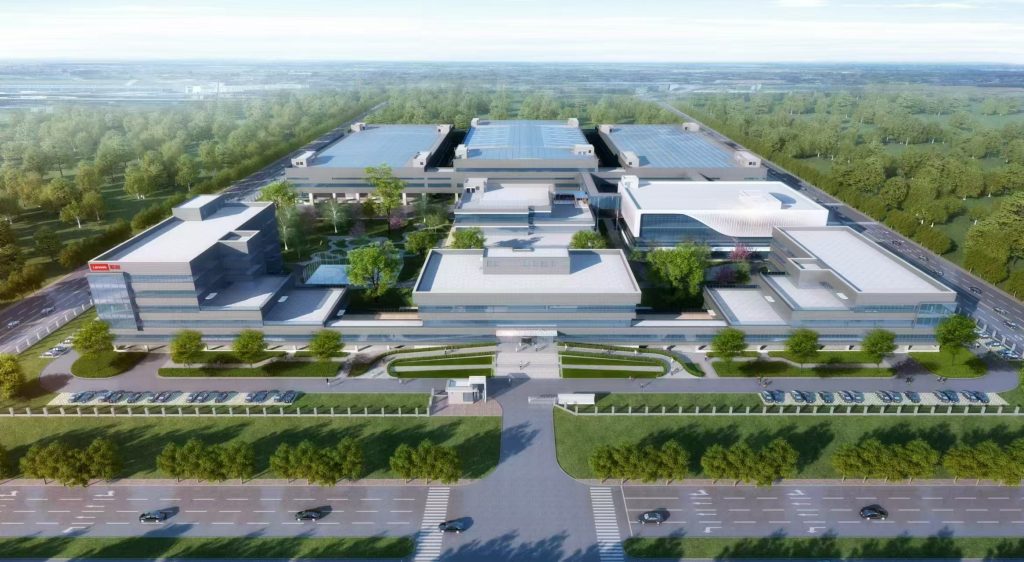
Lenovo’s Tianjin Smart Campus exemplifies success: certified as an Eco-level Carbon Neutrality Factory, it integrates diverse robots under a unified AI platform, deploys AI-driven energy management, rooftop solar, wind turbines, and waste-heat recycling.
Aerial view of Tianjin Smart Campus – Main View Source: Lenovo
Zheng’s pragmatic roadmap for Industry 5.0: First, strengthen IT foundations and supply-chain digitisation for full visibility and transparent decisions. Then layer OT automation (robots and AI) on accurate data.
Finally, upgrade worker skills, knowledge, and welfare. “Automation and robotics are part of OT, but the very starting point is IT.” This sequence, rooted in Lenovo’s global supply chain experience, ensures a sustainable competitive advantage—human-centric, energy-efficient, and scalable.
Risks and challenges
Technical limitations continue to persist. Zheng notes that physical AI struggles with tens of thousands of SKUs; high upfront costs deter some SMEs; and over-reliance on pre-programming risks brittleness.
Regulatory fragmentation, data privacy, and ethical AI alignment add complexity. Job displacement fears, though mitigated by collaboration models, require careful change management.
Opportunities ahead
Done right, AI-powered robots deliver not just efficiency but sustainability and workforce elevation. Physical AI and swarm intelligence handle low-value tasks, optimise energy, and enable 24/7 “dark” operations.
Asia’s manufacturing leaders who invest in digital foundations today will lead Industry 5.0 tomorrow—turning labour challenges into competitive strengths.
Allan is Group Editor-in-Chief for CXOCIETY writing for FutureIoT, FutureCIO and FutureCFO. He supports content marketing engagements for CXOCIETY clients, as well as moderates senior-level discussions and speaks at events.
Previous Roles
He served as Group Editor-in-Chief for Questex Asia concurrent to the Regional Content and Strategy Director role.
He was the Director of Technology Practice at Hill+Knowlton in Hong Kong and Director of Client Services at EBA Communications.
He also served as Marketing Director for Asia at Hitachi Data Systems and served as Country Sales Manager for HDS’ Philippine. Other sales roles include Encore Computer and First International Computer.
He was a Senior Industry Analyst at Dataquest (Gartner Group) covering IT Professional Services for Asia-Pacific.
He moved to Hong Kong as a Network Specialist and later MIS Manager at Imagineering/Tech Pacific.
He holds a Bachelor of Science in Electronics and Communications Engineering degree and is a certified PICK programmer.