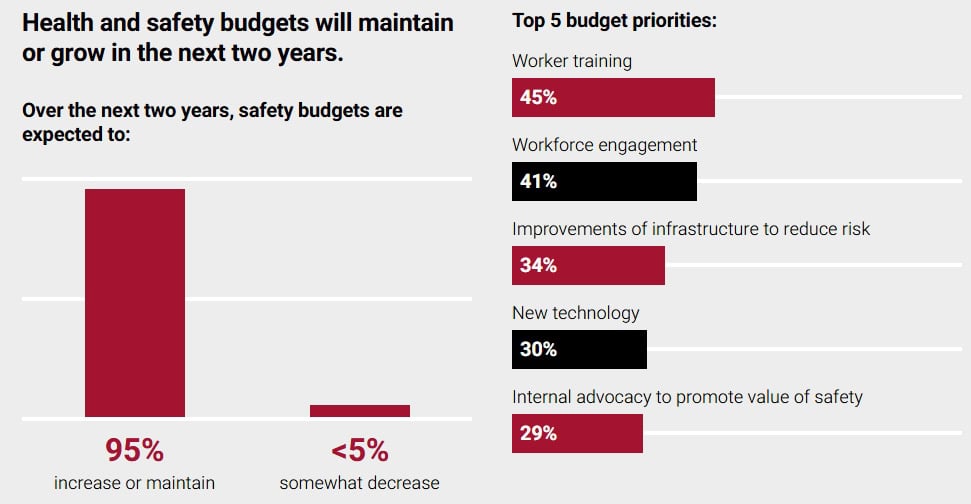
A global survey of 200 senior safety and operations professionals at organisations with 500 or more employees finds that 95% of safety leaders plan to maintain or increase health‑and‑safety budgets over the next two years, even as a persistent gap remains between written protocols and on‑the‑ground behaviour.
The research, compiled in a report titled Keeping People Safe: Global Data on the State of Workplace Safety, highlights that safety is widely seen as essential to business performance: 97% of respondents said workplace safety is fundamental to reliable productivity. Despite that consensus, 64% reported a disconnect between safety procedures and how work is actually carried out.
“It’s clear from the survey that a majority of experts support a change in safety culture across industries,” said Christine Gillies, chief product and marketing officer at Blackline Safety.
She noted respondents pointed to several causes for the gap, including misalignment between people, process and technology, protocol designers’ limited understanding of daily site realities, and the proliferation of additional processes that do not address root causes.
Survey respondents identified top budget priorities as worker training (46%), workforce engagement (41%), infrastructure improvements to reduce risk (34%), new technology (30%), and internal advocacy to promote the value of safety (29%). Nearly one‑third of safety leaders said improving the relevance and continuity of training — rather than simply increasing training volume — could build greater worker trust.
The study also found most organisations still set zero‑incident targets (76%), though many view those goals as unrealistic. While firms deploy a range of safety tools from PPE to communications equipment and advanced monitoring technologies, only 36% of leaders said a large proportion of workers have a high degree of trust in company tools and procedures; however, 92% indicated workers have at least some trust.
Adoption of data and analytics varies. Although 73% of respondents review incident reports and near‑miss records, only 33.5% spend time on predictive analytics aimed at forecasting and preventing future incidents. Nevertheless, a majority expect greater use of AI for safety: 65% anticipate AI risk‑prediction tools becoming increasingly important, and respondents reported high levels of trust in AI for safety data analytics and reporting (84%), training and simulation (83%), and predictive risk analytics (79%).
Gillies characterised a robust safety culture as resting on three pillars: training and communication, tools and technology, and data and reporting. “Most organisations have all three, yet few have them working together, which means gaps persist even when investment increases,” she said.
The report suggests practical routes for safety leaders seeking to narrow the protocol‑practice gap: align training to real‑world tasks, integrate tools with work processes, invest in two‑way engagement with workers, and increase the use of predictive analytics so near‑miss and incident data inform prevention.