Artificial intelligence is rapidly reshaping the global workplace, but a parallel shift is elevating the importance of distinctly human capabilities, according to new research from International Workplace Group (IWG). The study finds that 90% of HR leaders warn innovation will stall unless organisations actively prioritise human skills, signalling the emergence of a “Human Skills Economy”.
In Singapore, where national policy is accelerating AI adoption, this shift is particularly pronounced. Government-led initiatives such as the National AI Impact Programme aim to equip 100,000 workers with AI capabilities by 2029, while the newly formed National AI Council is tasked with ensuring that technological gains translate into quality jobs and sustainable wage growth. Yet, despite this momentum, adoption gaps remain: around 70% of businesses have yet to fully integrate AI into operations.
IWG’s findings highlight a growing disconnect between AI deployment and workforce readiness. While 73% of hybrid teams already use AI tools such as ChatGPT and 82% of organisations offer AI training, fewer than half of HR leaders believe they are effectively closing skills gaps. This suggests that implementation is outpacing the development of capabilities needed to maximise value.
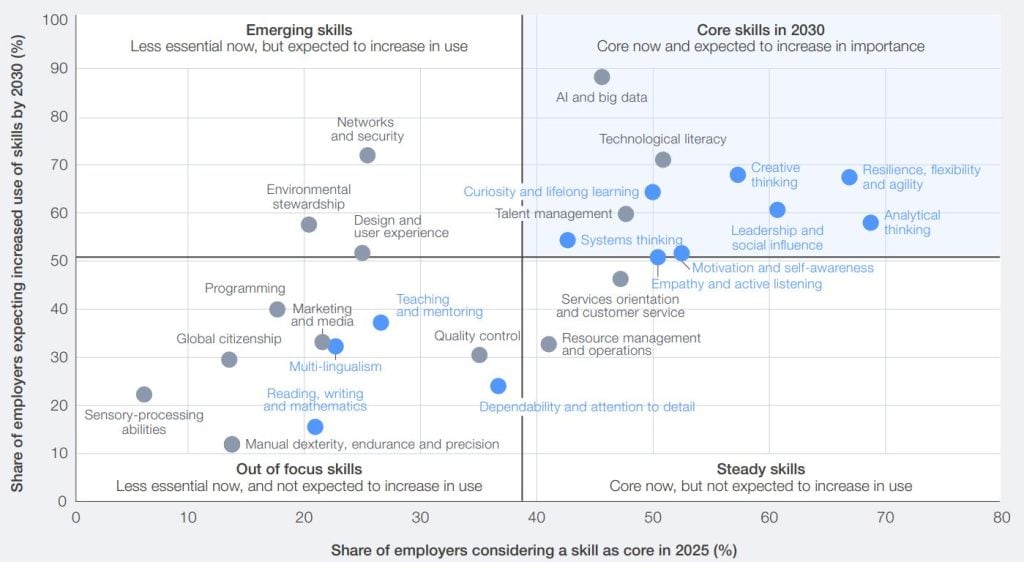
At the same time, the research underscores a clear boundary between machine efficiency and human contribution. A majority of HR leaders identify empathy (65%), complex decision-making (64%), and leadership (53%) as areas where AI cannot compete.
As a result, organisations are recalibrating performance models, positioning AI to handle repeatable tasks while human workers focus on judgement, creativity, and strategic direction.
Source: World Economic Forum
This shift is also reshaping hiring priorities. While technical proficiency remains essential, 66% of HR leaders now rank human skills above experience, education, and hard skills when evaluating candidates. Hybrid work environments are emerging as critical enablers, with 55% of respondents citing them as effective for cultivating leadership, collaboration, and trust.
Mark Dixon, CEO and Founder of IWG, said: “AI is redefining work at an unprecedented pace. The organisations that succeed will be those that combine AI’s efficiency with the uniquely human skills that drive innovation, leadership, and growth.”
As Singapore and other economies push forward with AI-driven transformation, the message for business leaders is clear: competitive advantage will depend not only on technological adoption, but on the ability to cultivate human capabilities that machines cannot replicate.