
ASEAN consumers remained broadly resilient in 2026, balancing optimism about the macroeconomic outlook with caution over personal finances, according to UOB’s latest ASEAN Consumer Sentiment Index.
The regional index held steady at 54, signalling continued overall optimism despite persistent geopolitical tensions and concerns over rising oil prices. The findings reflect a region where steady economic growth has underpinned confidence, even as households remain mindful of financial pressures.
Macro optimism drives sentiment
Stronger confidence in the macroeconomic environment was the primary driver of regional sentiment. The macro sub-index rose three points to 61, with 60 per cent of respondents expressing positive views on current economic conditions, and 61 per cent optimistic about the year ahead.

Suan Teck Kin, head of research, global economics and markets research at UOB, said: “ASEAN-5 economies remained resilient in the first half of 2026, with Singapore and Thailand outperforming expectations. Amid heightened geopolitical tensions, ASEAN remains a compelling investment destination for multinational corporations as companies diversify supply chains and expand their regional presence.”
He added that these trends are supporting employment growth and broader economic opportunities, reinforcing consumer confidence across the region.
Singapore posts strongest improvement
Singapore recorded the largest year-on-year gain, with its index surging nine points to 56. The increase was driven by improvements across both macroeconomic and personal finance indicators.
Positive perceptions of current economic conditions jumped 16 percentage points to 66 per cent, while expectations for future performance rose 13 points to 63 per cent. The uplift reflects strong economic momentum in the first half of 2026, supported by demand linked to artificial intelligence across manufacturing, trade, and services.
Government measures, including cost-of-living support and rebates, also helped ease household pressures, while gains in equity markets contributed to improved sentiment.
Thailand also registered gains, with its index rising four points to 51, supported by stimulus measures, tourism recovery, and export resilience.
Diverging trends across ASEAN
Vietnam remained the most optimistic market with an index of 63, despite a slight decline. Strong macroeconomic confidence and sustained foreign investment inflows continued to underpin sentiment.
In contrast, Malaysia and Indonesia saw softer readings. Malaysia’s index slipped to 50 amid rising concerns over living costs, while Indonesia’s fell to 49, reflecting external pressures and currency volatility.
Cautious households amid rising costs
Despite macro optimism, consumers across ASEAN remained measured about their personal finances. The micro sub-index edged down to 51, as concerns over household expenses, income security, and long-term commitments persisted.
While more respondents expect to be financially better off in the coming year, cost pressures across essential categories continue to shape a more cautious consumer outlook.

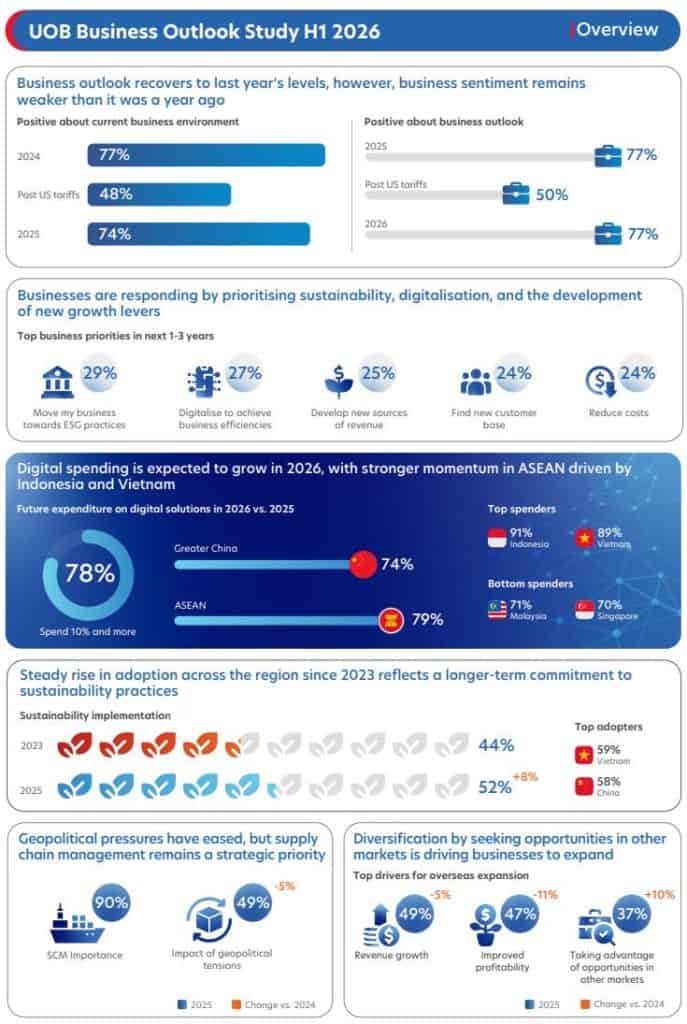
"Businesses are operating in an increasingly challenging environment, with geopolitical tensions and rising costs intensifying since 2024 and with outlooks softening, companies are looking beyond short-term cost pressures," said Eric Lian, head of group commercial banking at UOB. "The growing demand for digitalisation and sustainability capabilities signals clear intent by business to build resilience and position for sustainable growth amid continued uncertainty."