
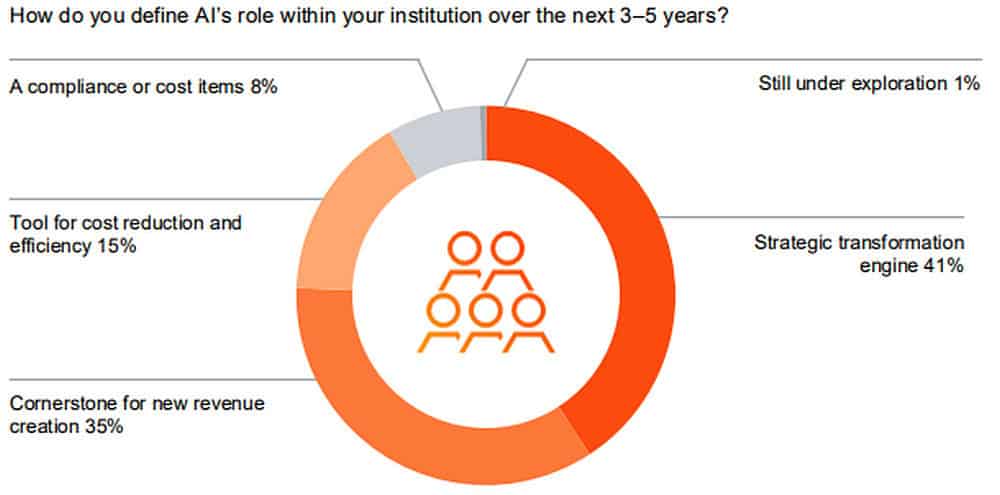
A PwC report surveying 201 financial‑services professionals across Mainland China and Hong Kong between October 2025 and January 2026 confirms what many COOs in Asia already feel: AI is being deployed for strategic transformation rather than merely for cost‑cutting efficiencies.
The report also exposes practical gaps — in spending, data access and skills — that will shape which organisations capture value.
The survey (PwC, March 2026) shows 57% of institutions are using AI to augment employees’ roles rather than replace them, and respondents reported benefits that include reduced risk, more effective compliance and new revenue streams.
Use cases vary by sector: anti‑money laundering and compliance are prominent in banking; customer service automation in insurance; and investment, portfolio and risk analytics in asset & wealth management (AWM).
Key issues for COOs and CHROs in Asia
- Investment shortfall: 61% of firms allocate 10% or less of technology budgets to AI, which PwC characterises as a 30–40% spending gap against global peers. COOs must therefore prioritise budget reallocation or phased capital programmes to avoid falling behind.
- Talent and culture: Only 29% of firms report an “AI‑first” culture. The report highlights a pressing need for people who understand “both the business and the algorithms.” CHROs should accelerate targeted reskilling, revise hiring profiles (data engineers, decision designers, AI ops) and introduce incentives to embed AI usage into daily workflows.
- Data constraints and governance: Data availability (30%) and regulatory concerns (20%) are top barriers; 90% of respondents rely primarily on proprietary internal data. For Asian COOs, this underscores the importance of solid data governance, lineage and secure sharing frameworks — particularly where cross‑border data flows and residency rules complicate sourcing external datasets.
- Organisational rigidity and legacy systems: 41% cited siloed strategies and 31% cited legacy systems as adoption blockers. Operational leaders should map legacy dependencies, prioritise API‑first modernisation and design integration phases that reduce disruption to customer‑facing services.
- Strategic rather than tactical ROI: While firms report ROI from AI, PwC notes many view AI as a source of strategic optionality — new products, improved market positioning and enhanced citizen/customer experience — rather than simply a route to lower costs.

"This is about more than efficiency gains,” says Matthew Phillips, PwC China financial services industry leader. “FIs see AI as an unmissable opportunity to transform their operating models and service offerings. But long-term investment will be required to overcome the challenges to wider AI deployment.”
Practical next steps recommended for COOs in Asia include reallocating technology budgets to create multi‑year AI investment plans; building cross‑functional centres of excellence to break silos; prioritising explainability and governance in procurement; and partnering with regulators early to ensure compliant experimentation.