A joint study by Mecalux and the MIT Intelligent Logistics Systems Lab has revealed that artificial intelligence (AI) has become a cornerstone of modern warehouse operations.
Based on a survey of over 2,000 logistics leaders across 21 countries including Brazil, Sweden, Canada, UK, China, Israel, Mexico, Germany, France, Italy, Czech Republic, Poland, UK, Australia, Netherlands, Spain, Argentina, Belgium, Romania, Japan and Portugal, reveal that AI is now embedded in 60% of warehouses worldwide, significantly reshaping productivity and workforce dynamics.
The findings underscore the critical role AI plays in enhancing logistical efficiency. With more than 90% of warehouses employing AI or advanced automation systems, the sector has achieved remarkable maturity.
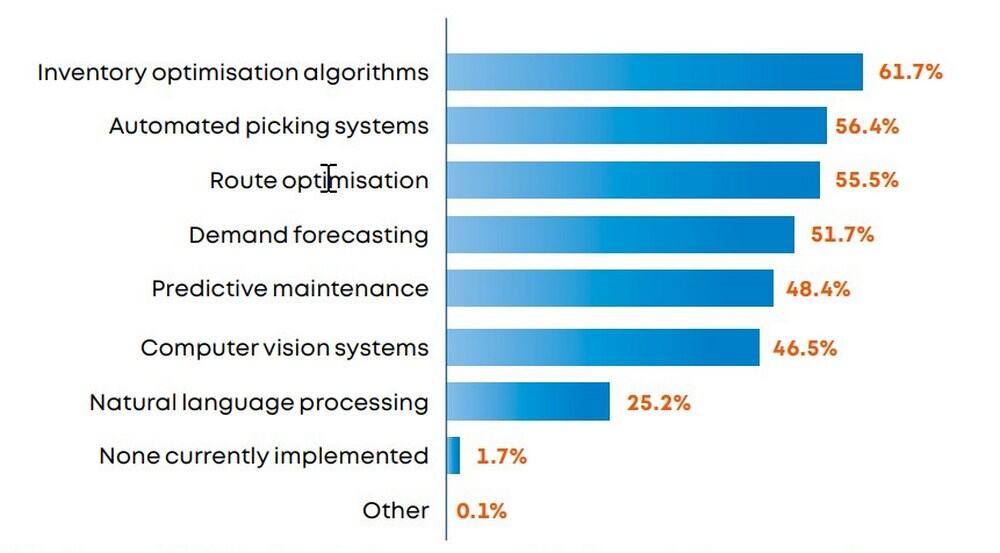
Source: The State of AI and Warehousing, Mecalux and MIT Intelligent Logistics Systems Lab, 2025
Over half of the organisations surveyed reported operating at advanced or fully automated maturity levels, particularly among larger firms with complex multi-site logistics.

"The data shows that intelligent warehouses outperform not only in volume and accuracy, but in adaptability," stated Javier Carrillo, CEO of Mecalux. Companies that have embraced AI are better positioned to navigate seasonal volatility, marked by increased resilience and predictability in operations.
The financial implications of AI adoption are equally promising, with many businesses allocating 11% to 30% of their warehouse technology budgets to AI initiatives.
The average payback period for these investments is just two to three years, driven by significant improvements in inventory accuracy, throughput, and labour efficiency.
This transition from exploratory spending to capability building highlights the urgent need for enterprises to invest in AI, influenced by cost-saving goals, rising customer expectations, and labour shortages.

Nevertheless, challenges remain regarding the integration of AI within existing systems. Dr. Matthias Winkenbach, director of the MIT ILS Lab, noted, “The hard part now is the last mile: seamlessly integrating people, data, and analytics." Barriers such as technical expertise, data quality, and implementation costs continue to obstruct scalability.
Contrary to fears of automation eroding jobs, the report reveals that AI fosters higher productivity and job satisfaction, with over three-quarters of organisations witnessing an increase in these areas post-implementation. Many also reported workforce growth, with new roles emerging for AI/ML engineers and data scientists.
Looking ahead, nearly all surveyed companies plan to expand their AI utilisation in the next two to three years, with 87% anticipating budget increases. Generative AI is poised to drive the next wave of innovations, automating processes from warehouse layout optimization to documentation.
As warehouses gear up for the holiday season, it is clear that AI is not merely an additive technology but is re-engineering the logistics landscape, empowering businesses to operate smarter and more efficiently.